How Long Should A Cover Letter Be in 2026? (The Definitive Guide)
Stop writing essays. Discover the perfect word count for email and attached cover letters to get more interviews.
29 days ago - Updated 11 days ago
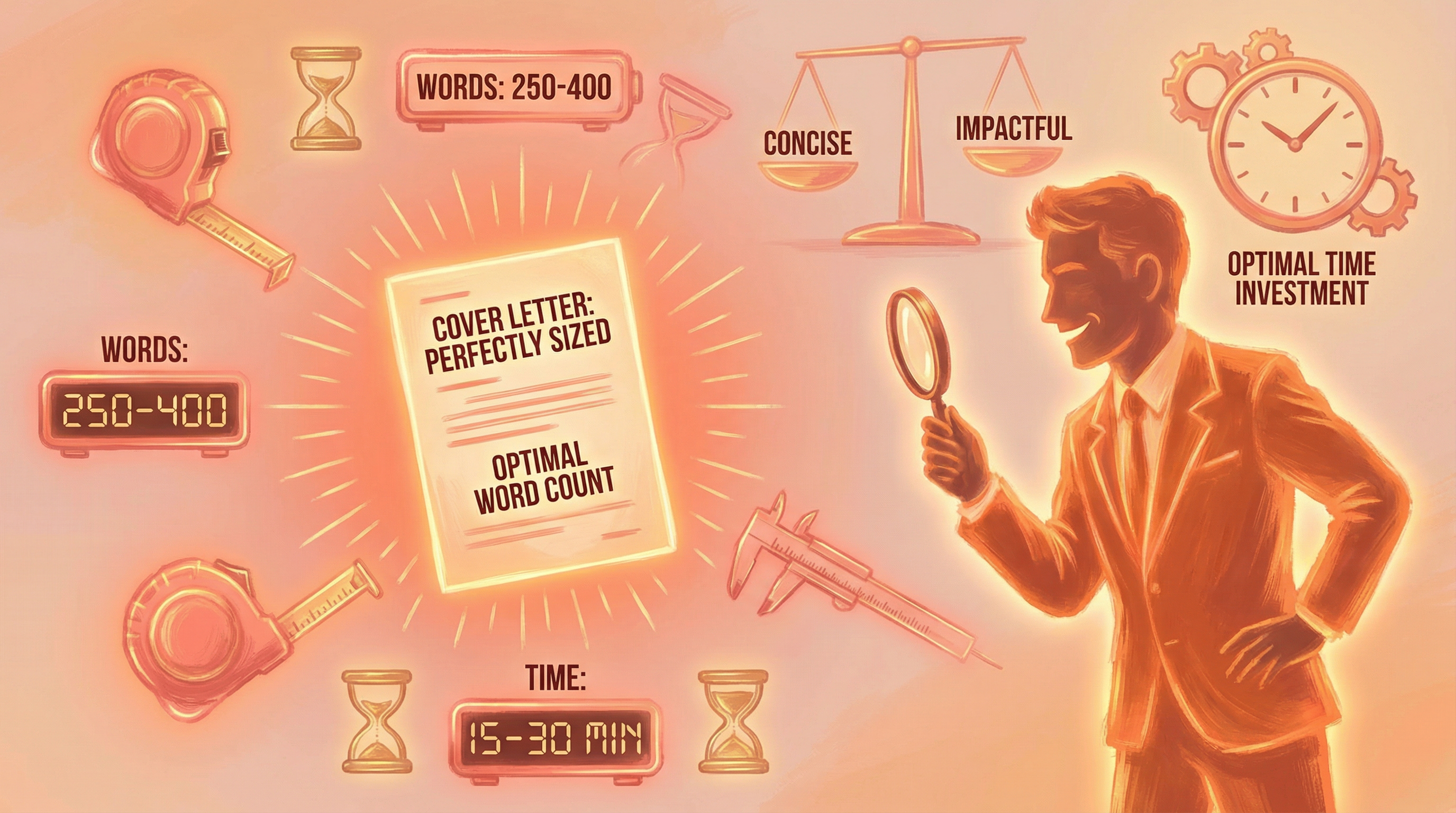
You've polished your resume, updated your portfolio, and found the perfect job opening. Now comes the dreaded question: How long should my cover letter be?
Should it be a detailed narrative of your life story? A quick "Here's my resume"? Or something in between?
In 2026, the hiring landscape has changed. Attention spans are shorter, and recruiters are busier than ever. The days of the full-page, single-spaced formal letter are fading fast.
Cover Letter Length Quick Guide
- Email body / Online portal: 100-200 words (3-4 short paragraphs)
- Attached PDF (formal): 250-400 words (half a page max)
- Networking email: 50-100 words (ultra-concise)
- Entry-level / Internships: 200-300 words (tighter focus)
- C-Suite / Academic: 400-600 words (rare exception)
The Golden Rule: If it doesn't add value, cut it. Every sentence should earn its place.
The 2026 Reality: 83% of hiring managers read cover letters even when not required, and candidates with tailored letters are 1.9x more likely to land interviews. But 81% of recruiters have discarded applicants based solely on their cover letter. Make yours count.
Let's dive into the specifics of modern cover letter length and how to make every word count.
The Golden Rule: Half a Page or Less
If you are attaching a formal cover letter document (PDF), the ideal length is 250 to 400 words.
Visually, this looks like half a page to three-quarters of a page. If your text is spilling onto a second page, you have written too much. If it's a dense block of text with no white space, you've also written too much.
Quick Comparison: Cover Letter Types by Length
| Type | Word Count | When to Use | Time to Read |
|---|---|---|---|
| Networking Email | 50-100 | Cold outreach, referrals, informational interviews | 15-30 seconds |
| Email Body Application | 100-200 | Startup jobs, casual companies, online portals | 30-45 seconds |
| Entry-Level / Internship | 200-300 | First jobs, internships, limited experience | 45-60 seconds |
| Attached PDF (Standard) | 250-400 | Traditional industries, formal applications | 60-90 seconds |
| Executive / Academic | 400-600 | C-suite, professorships, research positions | 2-3 minutes |
Pro Tip: If a recruiter can't read your entire cover letter in under 90 seconds, it's too long. Remember: 36% of hiring managers spend less than 30 seconds on cover letters.
Why Shorter is Better: The Data-Driven Case for Brevity
The numbers don't lie. Here's what recent research reveals about cover letter length:
- 36% of hiring managers spend less than 30 seconds reading a cover letter
- 70% of recruiters prefer shorter cover letters over lengthy ones
- 49% consider half a page ideal, while 26% prefer a full page, and 25% want just a few sentences
- 83% of hiring managers read cover letters even when not explicitly required
- Candidates who submit tailored cover letters are 1.9x more likely to land interviews
- 81% of recruiters have discarded applicants based solely on their cover letter
- 72% of hiring managers prioritize customization over generic applications
Here's the paradox: 84% of people believe traditional cover letters are outdated, yet 83% of hiring managers still read them. The resolution? Make them modern, concise, and impactful—not longer.
A concise cover letter demonstrates a critical soft skill: Communication. It shows you can:
- Respect the reader's time
- Synthesize information quickly
- Get to the point without fluff
- Prioritize what matters most
In a world where hiring managers review 100+ applications per job posting, brevity is your competitive advantage.
Scenario A: The "Email Body" Cover Letter (The Modern Standard)
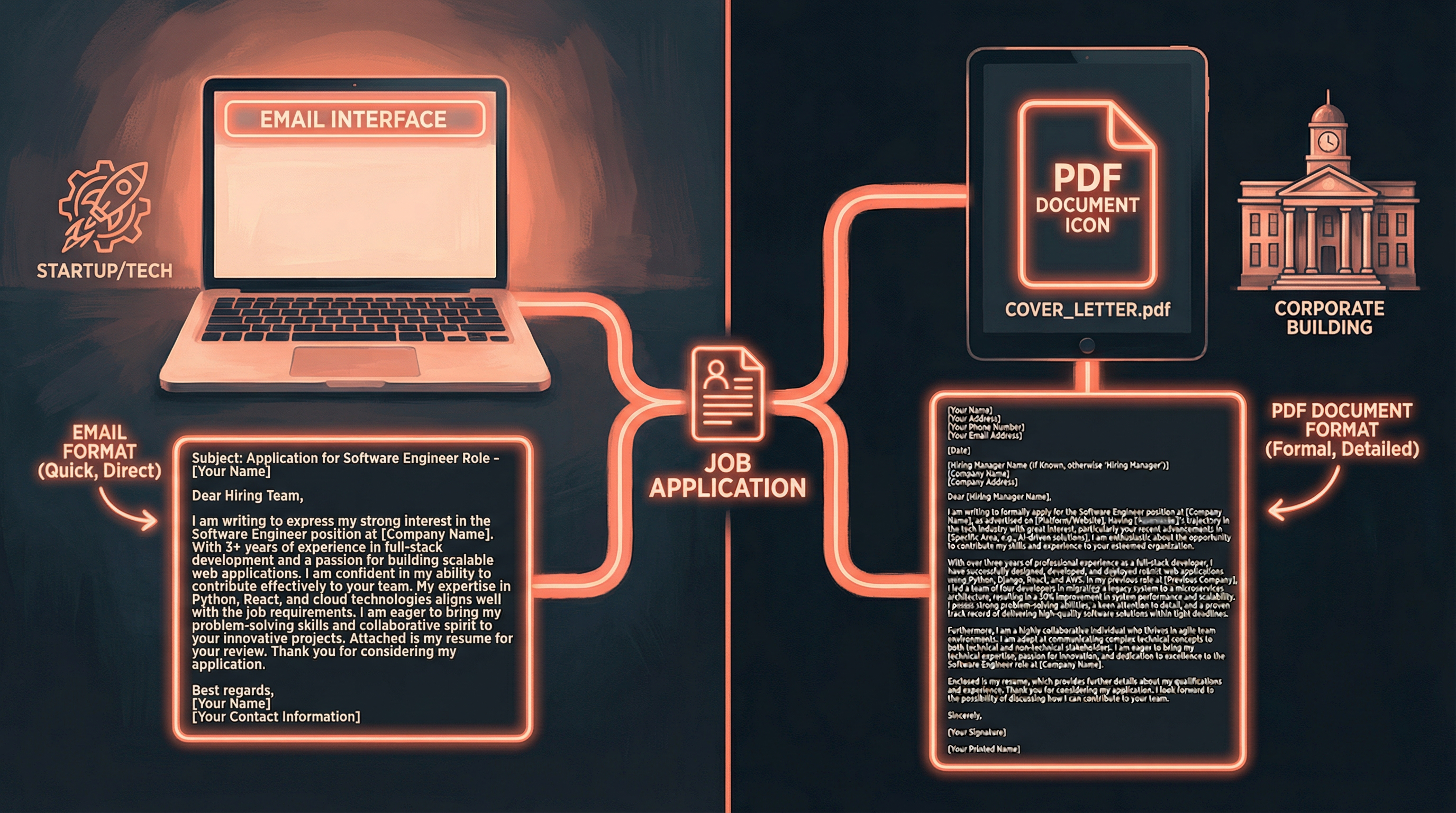
For many modern startups, tech companies, and casual work environments, you won't be attaching a separate PDF. You’ll be pasting your cover letter directly into the body of an email or a text box on an application portal.
Ideal Length: 100 – 200 words.
When the cover letter is the email itself, brevity is your best friend. Long emails get archived; short emails get read.
The Structure of a Short Email Application:
- Subject Line: Clear and specific (e.g., "Application for [Role Name] - [Your Name]").
- Salutation: Professional greeting.
- The Hook (1-2 sentences): Who you are and why you are emailing.
- The Value Prop (2-3 sentences): Highlight one major achievement relevant to the role.
- The Close (1 sentence): CTA (Call to Action) and link to portfolio/resume.
Example (Tech Startup):
"Dear [Hiring Manager Name],
I've been following [Company Name]'s growth in the [Industry] space for years, so I was thrilled to see the opening for a Senior Product Designer.
In my current role at [Current Company], I led the redesign of our mobile app, which increased user retention by 40% in three months. I am confident I can bring that same data-driven design focus to your team.
My resume and portfolio are attached. I'd love to hop on a quick call to discuss how I can help [Company Name] hit its Q3 goals.
Best, [Your Name]"
Word count: 82 words. Perfect for an email application.
Industry-Specific Email Length Tips
Different industries have different expectations:
- Tech / Startups: 100-150 words. Get to the point fast. Show metrics.
- Creative / Marketing: 150-200 words. Show personality, but stay concise.
- Finance / Consulting: 150-200 words. Professional tone, quantifiable results.
- Non-Profit / Education: 150-250 words. Show passion, but respect their time.
Scenario B: The "Attached Document" Cover Letter (Traditional)
If the job posting explicitly asks for a "Cover Letter" as a separate attachment, or if you are applying to a more traditional industry (Law, Academia, Government, Banking), you have a bit more room—but not much.
Ideal Length: 250 – 400 words (3–4 paragraphs).
The 3-Paragraph Formula
Don't ramble. Stick to this proven structure:
- Opening Paragraph (40-60 words): State the position you're applying for, express genuine interest, and briefly mention how you learned about the opportunity. Mention a mutual connection if you have one.
- Middle Paragraph(s) (150-220 words): This is the meat of the letter. Highlight 1-2 key achievements or experiences that directly align with job requirements. Use relevant keywords from the job description. Don't summarize your resume—tell a short story about a specific problem you solved.
- Closing Paragraph (40-70 words): Reinforce your enthusiasm, suggest next steps, and include a professional call to action (e.g., "I'd welcome the opportunity to discuss how my experience in X aligns with your team's needs").
Example Opening Paragraph (Traditional Format)
"I am writing to express my interest in the Marketing Manager position at [Company Name], as advertised on LinkedIn. With over five years of experience leading digital campaigns for Fortune 500 companies and a proven track record of increasing conversion rates by an average of 35%, I am confident I can bring immediate value to your team."
Word count: 55 words. Clear, confident, and sets the stage for the body paragraph.
The "Problem-Solution" Format (Modern Approach)
Rather than listing your achievements chronologically, try the problem-solution format—it's gaining traction in 2026, especially in tech roles:
Example:
"I noticed [Company Name] is scaling customer operations rapidly. In my role at [Current Company], I reduced customer onboarding time by 40% while maintaining a 98% satisfaction rate—a challenge I understand is critical for your growth.
My approach involved [brief methodology]. I'd love to discuss how I can apply these strategies to help [Company Name] achieve its Q2 scaling goals."
This format demonstrates immediate value and shows you've researched the company's challenges. It works particularly well when applying to startups, product roles, and companies undergoing rapid growth.
Scenario C: The "Networking Email" Cover Letter (Ultra-Short)
If you are reaching out to someone in your network, a recruiter you met at a conference, or cold-emailing a hiring manager, your "cover letter" should be 50-100 words max.
This is not the place for your life story. Your goal is to:
- Remind them who you are (if applicable).
- State your ask clearly.
- Make it easy for them to say yes.
Example Networking Email:
"Hi [Name],
We met at the [Event Name] conference last month, and I loved your insights on [Topic]. I noticed [Company Name] is hiring for a [Role], which aligns perfectly with my background in [Skill/Industry].
Would you be open to a 15-minute call to discuss the role and share any advice?
Thanks, [Your Name]"
Word count: 52 words. Short, respectful, and actionable.
Networking Email Pro Tips:
- Don't attach your resume immediately. Wait until they ask for it.
- Personalize every line. Generic networking emails get ignored.
- Propose a specific time commitment. "15-minute call" is less intimidating than "pick your brain."
Special Cases: When to Adjust Your Word Count
Entry-Level and Internship Positions: 200-300 Words
If you're applying for your first job or an internship, you can trim your cover letter to 200-300 words. You may have less professional experience, but you can compensate by highlighting:
- Relevant coursework and academic projects
- Volunteer work or campus leadership
- Demonstrated soft skills (teamwork, problem-solving, initiative)
- Personal projects or portfolio work
Keep the same three-paragraph structure but tighten each section. Focus on transferable skills and eagerness to learn.
Example Opening for Entry-Level:
"As a recent Computer Science graduate with a passion for front-end development, I was excited to see the Junior Developer opening at [Company Name]. During my senior capstone project, I built a React-based web app that improved campus event registration efficiency by 60%."
Academic and Senior Positions: 400-600 Words
These roles are exceptions to the standard rule. PhD positions, postdoctoral roles, and senior-level executive positions often warrant 400-600 words because these fields expect more detailed discussion of:
- Research interests and methodology (Academic)
- Teaching philosophy (Academic)
- Strategic vision and leadership philosophy (C-Suite)
- Career trajectory and industry impact (Senior roles)
Even in these cases, never exceed one page when printed.
Government Roles: Follow KSA Requirements
Some federal applications have strict requirements for addressing specific "KSAs" (Knowledge, Skills, and Abilities) in narrative form. Follow the instructions exactly, even if they request longer responses.
Common "Length" Mistakes to Avoid
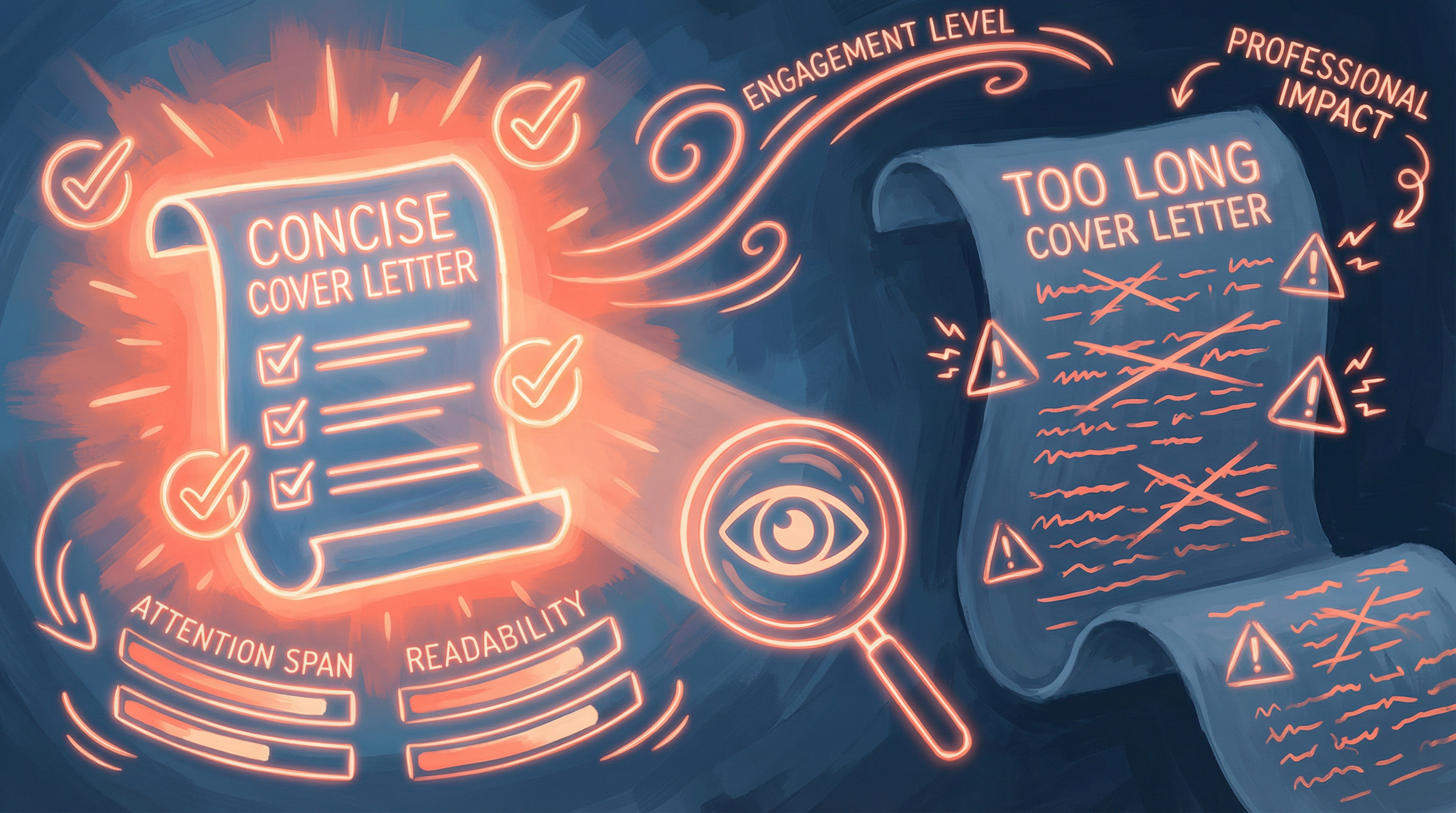
1. The "Resume Rewrite"
If your cover letter just repeats your resume in sentence form ("I worked at X from 2020 to 2022, then I worked at Y..."), it is too long and adds no value. Use the cover letter to show personality and context that the resume cannot.
❌ Bad (120 words):
"I graduated from State University in 2018 with a degree in Marketing. I then worked at ABC Corp from 2018-2020 as a Marketing Coordinator, where I managed social media accounts. Then I moved to XYZ Inc from 2020-2023 as a Marketing Manager, where I led a team of three people and managed various campaigns..."
✅ Good (45 words):
"At XYZ Inc, I led a team that increased email open rates by 45% using A/B testing and personalization. I'm excited to bring this data-driven approach to [Company Name]'s email marketing strategy."
What changed: Removed the chronological recap. Focused on one impressive achievement.
2. The "Wall of Text"
Even a 300-word letter can look too long if it is one giant paragraph. Break it up. Use bullet points for achievements. Use short sentences. White space makes your application look inviting.
❌ Bad:
One giant 300-word paragraph with no breaks, no emphasis, and no visual hierarchy.
✅ Good:
Three paragraphs of 50-100 words each, with strategic bold text on metrics and clear spacing between ideas.
3. The "Over-Explainer"
Don't use the cover letter to apologize for missing skills or explain employment gaps in excruciating detail. Focus on your strengths. Confidence is concise.
❌ Bad (80 words):
"I know the job posting asks for 5 years of experience and I only have 3, and I also don't have experience with [Specific Tool], but I'm a really fast learner and I'm confident I can pick it up quickly. I also took a year off to travel, but I'm ready to get back to work now..."
✅ Good (30 words):
"I've delivered measurable results in similar roles, including a 35% increase in customer retention. I'm eager to bring this track record to [Company Name]."
What changed: Lead with confidence. Don't highlight what you don't have.
4. The "Filler Phrase" Trap
Modern hiring values directness. Cut these outdated phrases:
- ❌ "I am writing to express my interest in..."
- ❌ "Please find my resume attached for your review..."
- ❌ "I believe I would be a good fit for..."
- ✅ "I'm excited to apply for the [Role] position at [Company]."
- ✅ "My experience in [X] aligns perfectly with your need for [Y]."
What to Cut (And What to Keep)
If your cover letter exceeds 400 words, here's your editing guide:
| Remove | Reason | Keep Instead |
|---|---|---|
| Lengthy company admiration (beyond 1-2 sentences) | Hiring managers want to know what you bring, not generic praise | Brief, specific mention of why this company interests you |
| Detailed resume duplication | The cover letter shouldn't repeat what's already in your resume | 1-2 achievements with context the resume can't provide |
| Filler phrases ("I am writing to express...") | Modern hiring values directness | Strong opening that gets right to the point |
| Long personal origin stories | Keep personal narrative to 2-3 sentences max | Brief, relevant context that explains your interest |
| Multiple unrelated achievements | Focus on 1-2 key qualifications only | Targeted accomplishments matching job requirements |
| Overly complex sentences | Clear, scannable writing matters more than eloquence | Short, punchy sentences with active voice |
What You Must Keep:
- Direct statement of the role you're applying for
- 1-2 specific achievements matching job requirements (with numbers/metrics when possible)
- Brief explanation of why you're interested in this specific company
- Clear demonstration that you've researched the role and organization
- Strong closing with a call to action
Formatting Tips to Make Your Cover Letter Look Shorter (Even If It Isn't)
Visual formatting matters as much as word count. A well-formatted 350-word letter will look more polished than a crammed 400-word letter. Here's how to maximize readability without inflating length:
Font and Spacing Guidelines
Font Size:
- Use 10.5–11 point font as optimal (standard 12 is acceptable; avoid smaller)
- Sans-serif fonts (Arial, Calibri) work well for screen reading
- Serif fonts (Times New Roman, Georgia) work well for PDF attachments
Margins and Spacing:
- Set 1-inch margins on all sides (0.75 inches minimum, never less)
- Use 1.0 or 1.15 line spacing for readability without excess space
- Keep paragraphs to 3-4 lines maximum (visual rule: no paragraph should take up more than 1/3 of the page)
- Include adequate white space around paragraphs—readability beats word count
Visual Formatting Do's:
- Use short paragraphs: 2-3 sentences max per paragraph
- Add white space: Leave a full line break between paragraphs
- Use bullet points: When listing 2-3 achievements or skills
- Bold key metrics: Makes numbers pop (e.g., "increased revenue by 40%")
- Left-align everything: Don't center or justify text
Visual Formatting Don'ts:
- Single-space everything: It looks overwhelming
- Use tiny margins: Recruiter sees "This person is trying to cram too much in"
- Write one giant paragraph: It screams "I don't respect your time"
- Use colored fonts or graphics: Unless you're in a creative field (and even then, be strategic)
- Go smaller than 10pt font: If you can't fit it in 11pt, your letter is too long
Pro Tip: Hiring managers prefer visual clarity over maximum word density. A clean, scannable 300-word letter beats a dense 400-word wall of text.
The Three Core Questions Every Cover Letter Must Answer
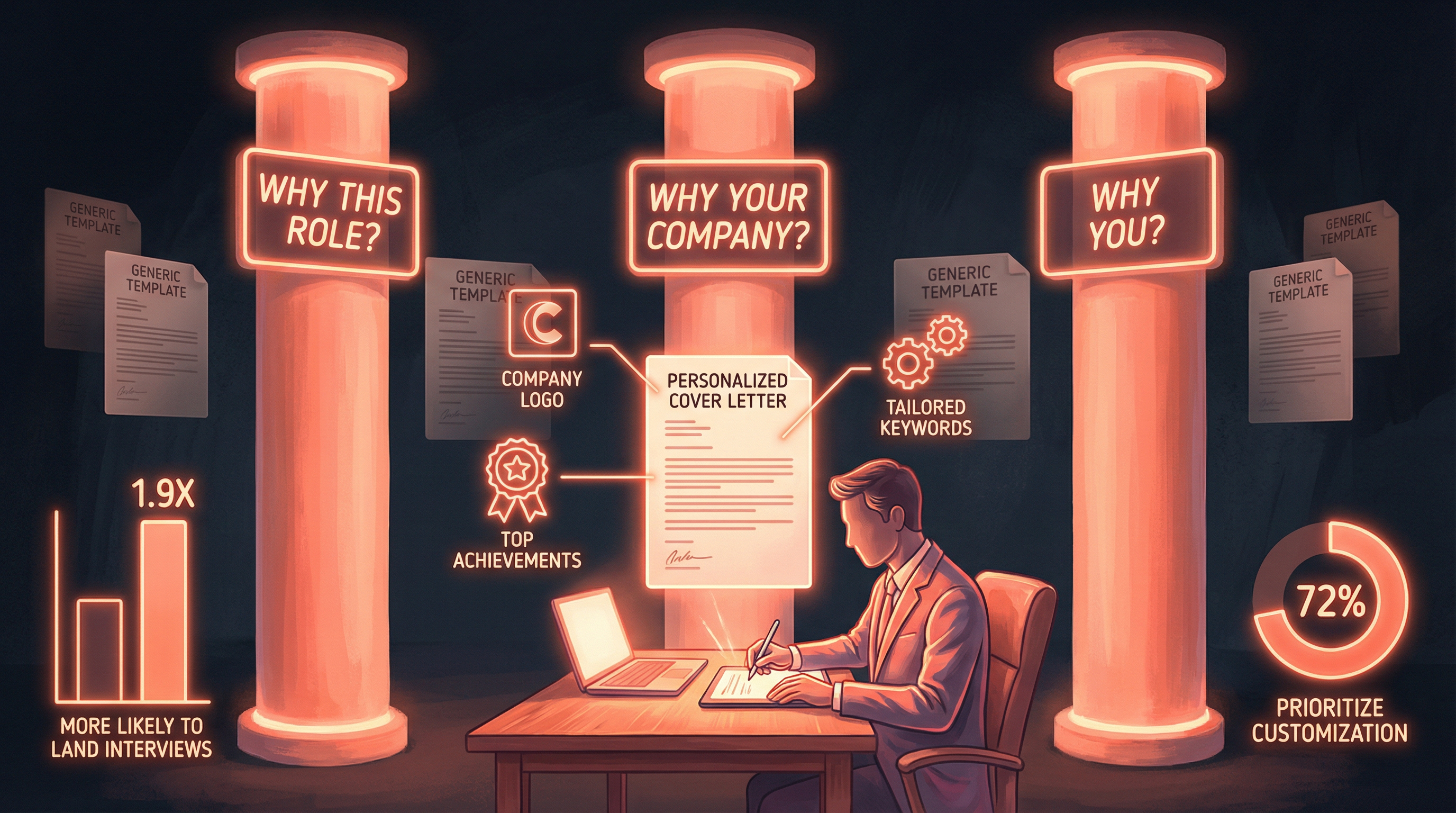
Here's what research consistently shows: there is no magic word count. The differences in response rates between a 250-word and a 350-word cover letter are minimal if both are well-written and tailored.
What matters is answering three core questions concisely:
1. Why This Role?
Show you understand the position and explain what attracts you to it. Be specific.
❌ Weak: "I've always wanted to work in marketing." ✅ Strong: "I'm excited about this Growth Marketing role because it combines data analysis with creative campaign development—exactly where I've had my biggest wins."
2. Why Your Company?
Demonstrate genuine knowledge of the organization's mission, products, or culture. Avoid generic praise.
❌ Weak: "Your company is a leader in the industry." ✅ Strong: "I've been following [Company]'s expansion into the European market and your recent partnership with [Partner]. My experience scaling international campaigns would be directly applicable."
3. Why You?
Provide 1-2 specific, relevant examples of how your skills solve their problems.
❌ Weak: "I have five years of experience in sales." ✅ Strong: "In my last role, I increased B2B sales by 45% in 12 months by implementing a consultative selling approach—precisely the skill set your job description emphasizes."
The Bottom Line: A cover letter that answers these three questions in 200 words will beat a rambling 500-word letter that doesn't. Hiring managers who spend 30 seconds reading are scanning for these answers. Make them easy to find.
Quality Over Quantity: Personalization Beats Length Every Time
Here's the uncomfortable truth: 72% of hiring managers prioritize customization over everything else. A 150-word perfectly tailored letter will outperform a 400-word generic one.
What Personalization Looks Like:
Generic (300 words, zero impact):
"I am a hard-working professional with excellent communication skills and a proven track record of success. I have always admired your company and would love the opportunity to contribute to your team..."
Personalized (180 words, high impact):
"I noticed [Company] recently launched its AI-powered customer service platform. Having led a similar implementation at [Current Company] that reduced response times by 60%, I understand the technical and change management challenges you're likely facing.
Your job posting mentions scaling the customer success team—my specialty. At [Company], I grew the CS team from 5 to 25 people while maintaining a 95% retention rate..."
Personalization Checklist:
- ✅ Hiring manager's name (not "To Whom It May Concern")
- ✅ Specific company achievement, product, or recent news
- ✅ Keywords from the actual job description
- ✅ Tailored achievement that mirrors their stated needs
- ✅ Company-specific reason why you're interested
Time Investment: Spend 15-20 minutes customizing each letter. It's better to send 5 personalized 200-word letters than 20 generic 400-word ones.
Frequently Asked Questions
How long should a cover letter be for an internal position?
100-200 words. You already work there, so skip the company research. Focus on why you're excited about the new role and what unique value you bring from your current position.
Can a cover letter be too short?
Yes. Anything under 75 words (for a formal application) looks lazy. You need at least 3-4 sentences to make a compelling case.
Should I write a different cover letter length for ATS (Applicant Tracking Systems)?
No. ATS systems parse content, not length. Focus on using relevant keywords from the job description, regardless of word count.
How long should a cover letter be if I'm changing careers?
300-400 words. You need space to explain your transferable skills and why you're making the switch. But don't go over half a page.
What if the job posting says "optional cover letter"?
Write one anyway—but keep it ultra-short (100-150 words). It shows you go the extra mile.
How do I count words in my cover letter?
- Microsoft Word: Tools → Word Count
- Google Docs: Tools → Word Count
- Online: Use a free tool like WordCounter.net
Should I use the hybrid approach (brief email + attached cover letter)?
Yes, this can work well. Write a brief 2-3 sentence introduction in the email body (50-75 words), then add "Please see my attached cover letter for more details." This accommodates:
- Convenience seekers: Can quickly scan your email
- Detail-oriented reviewers: Can read the full PDF
- Mobile readers: Email is easier to read on phones
Just make sure the email introduction is strong enough to stand alone if they never open the attachment.
Summary Checklist
 Before you hit send, use this final checklist:
✅ Word Count:
- Email / Text Box: 100-200 words
- Attached PDF: 250-400 words
- Networking Email: 50-100 words
✅ Formatting:
- Short paragraphs (2-3 sentences)
- Bullet points for achievements
- Plenty of white space
- Professional font (11-12pt)
✅ Content:
- Hook in the first sentence
- One specific achievement with numbers
- Clear call to action
- No typos or grammar mistakes
✅ Final Test:
- Read it out loud. If you're bored, they will be too.
- Cut any sentence that doesn't add value.
- Ask: "Would I read this if I had 30 seconds?"
Final Thoughts
Remember, the goal of the cover letter isn't to get you the job—it's to get the recruiter to read your resume with excitement.
In 2026, concise is confident. Every word should earn its place. A tight, focused 200-word cover letter will always outperform a rambling 600-word essay.
Your Action Plan:
- Target 250-350 words for most applications (slightly shorter than the 400-word max gives you breathing room)
- Answer the three core questions: Why this role? Why your company? Why you?
- Personalize ruthlessly: Spend 15-20 minutes customizing each letter
- Format for scannability: Short paragraphs, white space, bold metrics
- Attach as PDF unless explicitly told otherwise
The cover letter is no longer a formality. With 83% of hiring managers reading them and tailored letters making you 1.9x more likely to land interviews, this half-page document is your competitive advantage.
But that advantage only works when your letter is sharp, relevant, and respectful of the reader's time. In modern job hunting, shorter, more strategic cover letters outperform longer, generic ones.
Keep it short, keep it punchy, and you'll see better results.
Ready to write your cover letter? Use the templates and examples above as a starting point, customize them for your industry, and watch your response rates climb.
Was this article helpful?
Table of Contents
Cover Letter Length Quick Guide
The Golden Rule: Half a Page or Less
Scenario A: The "Email Body" Cover Letter (The Modern Standard)
Scenario B: The "Attached Document" Cover Letter (Traditional)
Scenario C: The "Networking Email" Cover Letter (Ultra-Short)
Special Cases: When to Adjust Your Word Count
Common "Length" Mistakes to Avoid
What to Cut (And What to Keep)
Formatting Tips to Make Your Cover Letter Look Shorter (Even If It Isn't)
The Three Core Questions Every Cover Letter Must Answer
Quality Over Quantity: Personalization Beats Length Every Time
Frequently Asked Questions
Summary Checklist
Final Thoughts
Share this article
Other articles
How to Write a Cover Letter That Actually Gets Read
Your guide to writing cover letters that get noticed by recruiters and beat the ATS.
Cover Letter Opening Lines That Hook Recruiters (18 Proven Examples)
Ditch the boring intro. These attention-grabbing first sentences will make hiring managers actually want to read your cover letter.
Do You Really Need a Cover Letter? (+ When to Skip It in 2026)
The definitive answer to whether cover letters still matter—plus the exact scenarios when you can skip them without hurting your chances.