Career Change at 30, 40, or 50: A Step-by-Step Guide to Reinventing Your Career
A comprehensive guide to pivoting your career mid-life, with strategies for self-assessment, transferable skills, and overcoming age bias.
12 days ago - Updated 5 days ago

The idea of changing careers in your 30s, 40s, or 50s can feel both exciting and daunting. Yet career changes are more common—and more successful—than most people realize.
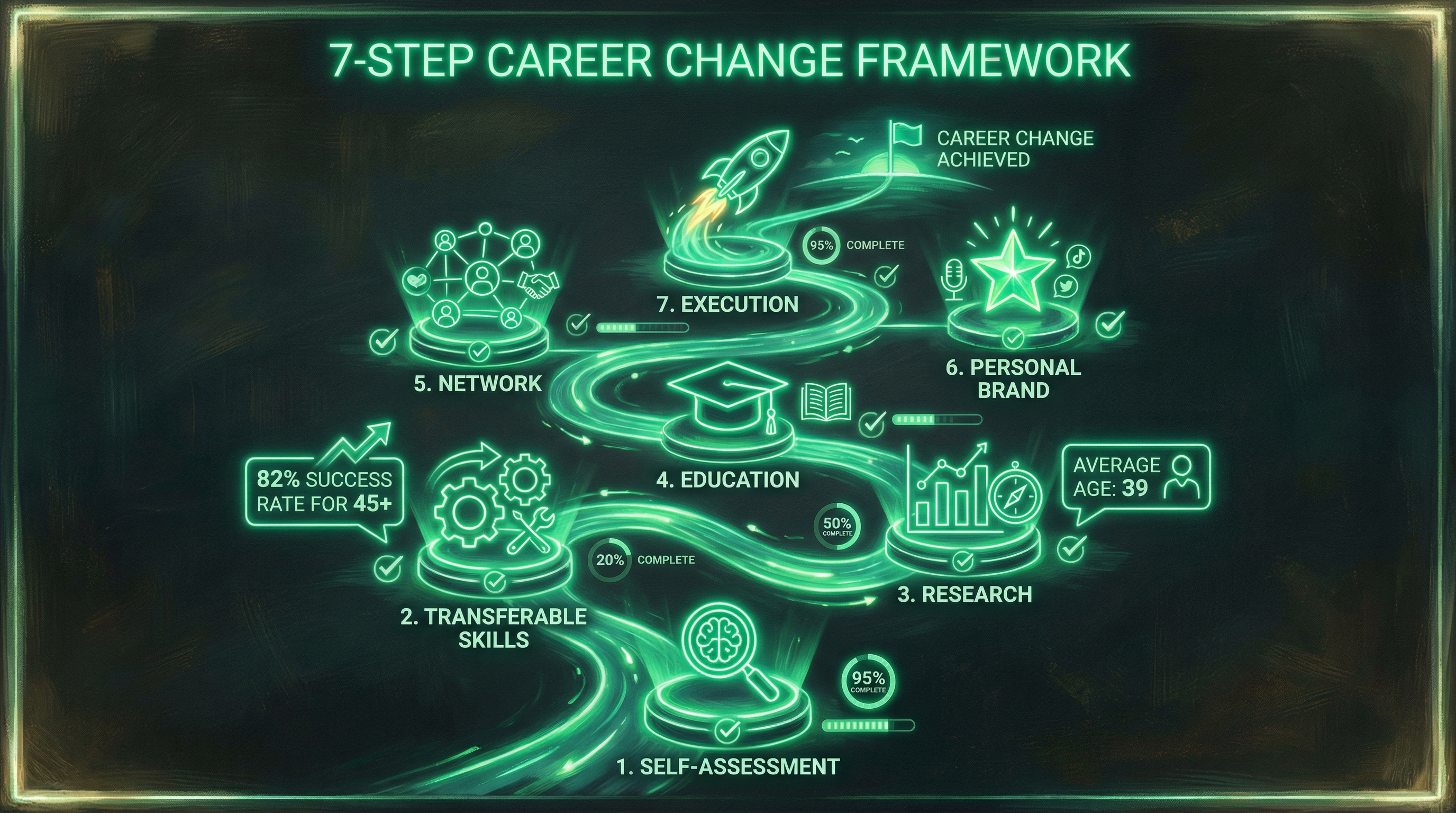
Key Insight: According to recent data, the average person changes careers at age 39, and an impressive 82% of workers over age 45 who attempted a career switch successfully transitioned to their new field.
The traditional concept of staying with one employer for a lifetime has become increasingly rare. Today's workforce is more dynamic, and professional pivots have become a strategic move for those seeking greater fulfillment, better work-life balance, or alignment with their core values.
This comprehensive guide walks you through every stage of a career change, from initial self-assessment to successfully landing your new role. Whether you're reconsidering your career at 30, contemplating a mid-life pivot at 40, or planning a meaningful transition at 50, this roadmap provides actionable strategies grounded in current research and real-world success stories.
Is a Career Change Right for You? 🤔
Before committing to a full career overhaul, it's essential to distinguish between job dissatisfaction and genuine career misalignment.
Signs You Should Consider a Career Change ✅
You're unfulfilled despite success. You've achieved recognition in your current field, but the work no longer aligns with your values or interests.
Your industry is declining. Technological disruption or market forces are eliminating roles in your sector, and you want to proactively pivot rather than wait.
Work-life balance is unsustainable. Your current career demands constant overtime, travel, or emotional labor that compromises your personal well-being.
You're passionate about something completely different. You've discovered a field or role that genuinely excites you in ways your current work never has.
Compensation no longer justifies the cost. You're earning less relative to peers in other industries or your salary doesn't reflect the effort you're investing.
When to Stay and Seek a Job Change Instead ⚠️
Sometimes, the issue isn't your career—it's your specific job. Consider staying in your industry if:
- You love the work but not your current employer
- Leadership, company culture, or remote work options are the real problems
- Switching roles within the same field would address your concerns
- You have deep expertise you'd prefer to leverage rather than abandon
Important: The distinction matters because job changes are faster, less risky, and often require less retraining than full career pivots.
Career Change by Age: What You Need to Know 📅
Career transitions look different at 30, 40, and 50. Understanding the unique advantages and challenges of your stage will help you craft an age-appropriate strategy.
Career Change in Your 30s 🚀
Advantages:
- You have substantial work experience (8-12+ years) but decades of earning potential ahead
- Employers view you as mature and reliable yet capable of learning and adapting
- The pivot is less risky financially; you have time to recover from any income dips
- Many industries actively recruit talented professionals mid-career
Challenges:
- You may feel you've already "chosen" your path
- Returning to entry-level may feel like a step backward
- Student loan or family financial obligations may limit flexibility
Strategy for Your 30s: Leverage your experience. You're not starting over—you're pivoting strategically. Identify roles that value your existing expertise while offering growth in a new direction. Consider careers in high-growth fields like technology, sustainability, healthcare, or digital marketing.
Career Change in Your 40s 💼
Advantages:
- You have 15-20+ years of experience and proven leadership skills
- 📈 Research shows that professionals who change jobs in their 40s see an average wage increase of 7.4%
- You're statistically more likely to remain employed at age 60 if you change jobs mid-career
- Your expanded network and maturity are significant assets
Challenges:
- Ageism is more prevalent; some employers hold stereotypes about older workers
- You may worry about competing against younger candidates
- Retraining costs can feel prohibitive alongside financial obligations
Strategy for Your 40s: Position yourself as a consultant or project lead rather than an entry-level hire. Emphasize leadership, mentoring, and cross-functional project management. Many 40-something career changers successfully pivot by leveraging their expertise in new domains—moving from operations to sustainability, for example, or from finance to nonprofit management.
Career Change in Your 50s 🎯
Advantages:
- You bring irreplaceable expertise, judgment, and problem-solving ability
- You may have paid off major debts, offering greater financial flexibility
- Mentoring and leadership opportunities are abundant
- Some employers specifically seek senior talent for consulting and expertise roles
Challenges:
- Age discrimination is most prevalent in this group (18% of 50-59 year olds report experiencing it)
- Only 11% of workers over 50 actively pursue career changes despite 80% considering it
- Limited time horizons may concern traditional employers
- Retraining may feel less relevant if you're considering semi-retirement
Strategy for Your 50s: Embrace your seniority. Consider roles that capitalize on your deep knowledge: executive coaching, consulting, board positions, mentoring, or starting your own business. If you want traditional employment, target companies with mature workforces or industries facing talent shortages (healthcare, skilled trades). Highlight stability, reliability, and the mentoring value you bring.
The 7-Step Career Change Framework 🗺️
 A structured approach significantly increases the likelihood of a successful career change. This framework breaks the process into manageable phases.
Step 1: Self-Assessment and Clarity 🔍
Before you begin researching industries or updating your resume, invest time in deep self-reflection.
Complete a comprehensive self-assessment:
- Values: What matters most to you? (Autonomy, impact, financial security, creativity, helping others, learning?)
- Strengths: What are you naturally good at? Ask colleagues and mentors for honest feedback.
- Interests: What topics excite you outside of work? What could you talk about for hours?
- Skills: What capabilities have you built over your career? (Technical and interpersonal)
- Life stage: What are your financial obligations, health considerations, and personal responsibilities?
Use assessment tools like the Myers-Briggs Type Indicator (MBTI), CliftonStrengths, or O*NET Interest Profiler to gain additional insights.
Articulate your "why." Write out why you want to change careers. Be specific. "I want more money" is less powerful than "I want to contribute to renewable energy solutions while maintaining work-life balance and earning a sustainable income." Your "why" becomes your north star when the transition gets difficult.
Step 2: Identify Your Transferable Skills 🔄
Transferable skills are your secret weapon. These are abilities you've developed in your current career that apply directly to new roles—helping you avoid starting at entry level.
Two types of transferable skills to catalog:
Hard skills (technical, measurable abilities):
- Project management
- Data analysis
- Financial modeling
- Coding or software proficiency
- Writing and content creation
- Research and strategy
- Budget management
- Quality assurance
Soft skills (interpersonal and behavioral):
- Leadership and mentoring
- Communication and presentation
- Problem-solving and critical thinking
- Stakeholder management
- Adaptability and resilience
- Emotional intelligence
- Negotiation
- Cross-functional collaboration
Create a skills inventory:
List your top 15-20 skills. For each, note:
- How you've used it in your current role
- Specific examples of impact (quantified where possible: "Led cross-functional team of 12 to deliver $2M project on time")
- How it applies to your target career
This inventory becomes the foundation for your resume, LinkedIn profile, and interview narratives.
Step 3: Research Your Target Career and Market 📊
Curiosity and data-driven research reduce risk.
Explore potential career paths:
- Browse job descriptions for roles that interest you. What qualifications and skills are consistently required?
- Identify skills gaps between your current inventory and target roles.
- Research salary ranges, growth projections, and work-life balance expectations.
- Join industry associations, online communities, and forums to understand trends and pain points.
Use multiple research sources:
- Job boards (LinkedIn, Indeed, Glassdoor): Read 20-30 job postings in your target role to identify patterns
- BLS Occupational Outlook Handbook: Understand employment trends and growth projections
- Industry reports: What are the biggest challenges and opportunities?
- Podcasts and YouTube channels from professionals in your target field
- Company websites: Learn about organizational culture and typical roles
Test assumptions through informational interviews (detailed below). Talking to real people in the field often reveals insights job postings don't.
Step 4: Bridge the Skills Gap Through Education and Training 📚
Based on your gap analysis from Step 2, create a targeted learning plan.
Types of training to consider:
Online certificates and bootcamps (3-12 weeks, often $500-$5,000):
- Google Career Certificates (IT Support, Project Management, Data Analytics)
- HubSpot Academy (Digital Marketing, Sales)
- CompTIA certifications (IT and cybersecurity)
- Coursera and Udemy specialized courses
Degree-based programs (6 months to 2 years, $5,000-$50,000+):
- Master's degrees in growing fields
- Diploma programs in healthcare, trades, or specialized technical areas
- Many universities now offer part-time and online options for working professionals
Hybrid approaches:
- Combine online courses with volunteer projects or freelancing
- Join apprenticeships or paid internship programs
- Pursue micro-credentials and digital badges that stack over time
Key principle: You don't always need a formal degree. Employers increasingly evaluate candidates on skills and demonstrated capability rather than credentials alone. A portfolio of work, certifications, and volunteer projects can be equally compelling.
Step 5: Build Your Professional Network 🤝
Your network is often your fastest path to opportunity. Most job openings are filled through connections, not job boards.
Activate your existing network:
- Reach out to 10-15 former colleagues, mentors, and acquaintances who work in your target field or adjacent areas
- Be transparent: "I'm exploring a career change and would value insights from people with experience in [field]. Would you be open to a brief conversation?"
- Ask specific questions, not just "Do you know of any jobs?"
Conduct informational interviews (20-30 conversations if possible):
An informational interview is a 20-30 minute conversation with a professional in your target field. The goal is learning, not asking for a job.
How to request an informational interview:
Send a personalized LinkedIn message or email:
"Hi [Name], I've been following your work in [field] and am impressed by [specific accomplishment or project]. I'm currently exploring a career transition into [industry/role] and would value 20-30 minutes of your time to learn about your experience and the landscape in [field]. I'm happy to work around your schedule. Thank you for considering."
Questions to ask: 💬
- How did you transition into [role/industry]?
- What skills are most valuable in your role that might not be obvious from a job description?
- What are the biggest challenges in this field right now?
- What does a typical day/week look like?
- How is AI or technology reshaping roles in your industry?
- For someone coming from [your background], what's the fastest path in?
- What would you do differently if you were starting your career today?
Advanced networking tactics:
- Attend industry conferences and volunteering events where you'll meet professionals naturally
- Join LinkedIn groups and participate thoughtfully in discussions
- Connect with 5-10 new relevant professionals on LinkedIn each week
- Follow industry leaders and comment substantively on their posts
Step 6: Rebrand and Reposition Yourself 🎨
Your resume, LinkedIn profile, and personal narrative need to reflect your pivot.
Rewrite your resume with your new career in mind:
- Lead with a professional summary that positions your pivot: "Strategic operations leader transitioning to environmental sustainability. 12 years of experience driving process efficiency and cross-functional collaboration. Now applying expertise in renewable energy and carbon reduction initiatives."
- Reframe job descriptions to emphasize transferable skills relevant to your target role. If you managed large budgets, highlight that for a finance pivot. If you led teams, emphasize that for management roles.
- Include education, certifications, and volunteer work prominently, especially if relevant to your new field
- Use keywords from job descriptions in your target field (ATS optimization)
- Quantify impact wherever possible ("Reduced operational costs 23%," "Mentored 8 junior professionals")
Optimize your LinkedIn profile:
- Update your headline to reflect your pivot: "Operations Leader | Transitioning to Sustainability | Open to Environmental Roles"
- Rewrite your summary to tell your career transition story
- Add new certifications and skills to the skills section
- Highlight volunteer work and projects in your target field
- Request recommendations from colleagues that speak to your transferable strengths
- Engage with content in your target industry (comment, share, post)
For advanced strategies on maximizing LinkedIn for your career transition, explore our 40 LinkedIn tips and tricks for career success to build your network effectively in your new field.
Craft your career transition narrative:
When you interview or network, you'll explain your pivot. This narrative should:
- Acknowledge your past: "I've had a rewarding 15-year career in [field], where I developed strong expertise in [skills]."
- Explain the motivation: "Over time, I realized I'm most energized by [value/type of work/impact], which led me to explore [new field]."
- Show intent: "I've taken [specific actions: completed certifications, volunteered, conducted research] to prepare for this transition."
- Connect the dots: "My background in [relevant skills] positions me well for [target role] because [specific connection]."
- Express enthusiasm: "I'm excited about the opportunity to contribute to [industry/mission]."
Example: "I spent 12 years in marketing but increasingly realized my passion was environmental sustainability. I completed Google's Project Management Certificate, volunteered with a nonprofit on their sustainability initiative, and conducted extensive informational interviews with people in green energy. I'm drawn to renewable energy roles where I can leverage my project management and stakeholder communication skills while contributing to the climate solutions mission."
Step 7: Execute Your Transition 🚀
Once you've prepared the ground, it's time to actively pursue opportunities.
Job search best practices:
- Tailor applications: Each cover letter and resume should directly address the job description
- Use multiple channels: Combine job boards, networking conversations, recruiters, and company direct outreach
- Apply strategically: Quality applications to 10-15 well-matched roles beat 100 generic applications
- Pursue the hidden job market: Many roles are filled before they're posted. Informational interviews and networking often lead to opportunities not on job boards
- Consider contract or interim roles: These can provide entry into a new field or company while you build experience
- Negotiate thoughtfully: Even if you're changing fields, you may not need to accept a significant salary cut. Research market rates and be prepared to discuss your unique value
During interviews: 🎤
- Be confident about your transferable skills—companies want the fresh perspectives you bring
- Address the elephant in the room if it's relevant: "I know I'm coming from a different industry, but [specific example] shows I can quickly acquire new technical knowledge"
- Ask insightful questions that show you've researched the company and industry
- Share specific examples of your problem-solving and adaptability
Building Your Transferable Skills 💪
 Understanding and effectively communicating your transferable skills is central to a successful career change. Here's how to maximize this asset.
The Skills Transferability Matrix
Create a visual map of your skills and how they apply to your target role:
| Your Current Skills | Target Role Application | Evidence/Example | Gap? |
|---|---|---|---|
| Budget management (15 years) | Cost optimization in green energy | Reduced operational budget 23% while maintaining service levels | No |
| Leadership of 8-person teams | Project management in tech | Led cross-functional teams of 10+ to deliver on complex projects | No |
| Client communication | Stakeholder management | Managed relationships with 50+ enterprise clients | No |
| Process improvement mindset | Systems thinking in nonprofit | Created workflows that improved team efficiency 40% | No |
| (Skill gap) | Data analysis | None—need training | Yes |
This matrix helps you:
- Identify which skills you can immediately leverage
- Pinpoint specific gaps to address through training
- Prepare concrete examples for interviews
Soft Skills That Cross All Industries
Certain soft skills are universally valued and often your strongest assets:
Leadership and mentoring: If you've managed people, led projects, or mentored colleagues, emphasize this. Leadership competence transcends industries.
Communication: Your ability to explain complex concepts, present ideas, and influence stakeholders applies everywhere. Use specific examples.
Problem-solving: Describe a complex challenge you've tackled from your previous field and the analytical approach you took. The methodology matters more than the industry.
Adaptability: Highlight times you've navigated change, learned new systems, or pivoted approaches based on new information.
Emotional intelligence: Your ability to work across personalities, manage difficult conversations, and collaborate effectively is increasingly valued.
Project management: Whether you had the title or not, if you've coordinated complex initiatives, this is gold across industries.
Financial Planning for Your Career Pivot 💰
A career change often involves financial risk. Strategic planning minimizes that risk and provides peace of mind.
Assess Your Current Financial Situation
Before making any moves, take a comprehensive financial snapshot:
Income and expenses:
- Document all monthly income sources
- List all monthly expenses (fixed and variable)
- Calculate your current savings and investments
- Assess outstanding debts (mortgage, loans, credit cards)
Emergency fund:
- Financial experts recommend 3-6 months of living expenses for general job searches
- For a significant career change (especially in your 40s-50s), consider 6-12 months of expenses
- Your emergency fund is your financial runway—how long you can sustain yourself if income drops
Retirement savings:
- Don't neglect retirement contributions during your transition
- If you're leaving a job, understand your options for 401(k) rollovers or IRAs
- Many career changers can negotiate start dates to maintain contribution continuity
Create a Transition Budget
Map out your finances during the change:
| Category | Monthly Amount | Notes |
|---|---|---|
| Essential Expenses | ||
| Housing | Rent/mortgage | |
| Utilities | Electric, water, internet | |
| Food | Groceries only, minimal eating out | |
| Transportation | Fuel/transit | |
| Insurance | Health, car, other essential | |
| Debt payments | Minimum payments on loans | |
| Subtotal Essential | ||
| Optional Expenses | ||
| Dining/entertainment | Reduce by 50-75% during transition | |
| Travel | Pause non-essential travel | |
| Shopping | Essential only | |
| Subtotal Optional | ||
| Transition Costs | ||
| Training/certification | Front-load if possible | |
| Networking events | Build into budget | |
| Job search | Minimal in 2025 (mostly free) | |
| Subtotal Transition | ||
| TOTAL MONTHLY |
Calculate your runway: Divide your savings by total monthly expenses. This shows how many months you can sustain yourself. Ideally, you want at least 3-6 months covered before quitting.
Extend your runway:
- Supplement with freelance or part-time work in your current field (often sustainable during job search)
- Negotiate a flexible exit with your current employer (reduced hours, project-based work)
- Consider a bridge role or interim position that pays less but continues income flow
Tax Considerations
Career transitions can affect your taxes:
- Estimated taxes: If self-employed or freelancing during transition, you may need to pay quarterly estimated taxes
- Deductions: Job search expenses (certification courses, networking events, relocation) may be deductible in some cases
- Retirement contributions: Understand tax implications of 401(k) rollovers or early withdrawals
- Severance or signing bonuses: These have tax implications; consult a tax professional
Overcoming Age Barriers and Ageism 🛡️
Age discrimination is real, particularly for workers over 40. However, research also shows that with the right approach, age becomes an advantage rather than a liability.
Understanding Age Bias
The statistics are sobering: 59% of recruiters admit to making age-based assumptions, and nearly half consider candidates over 57 "too old." However, research contradicts these biases:
The Truth About Older Workers:
- Older workers learn technology just as quickly as younger workers
- Older workers have lower absenteeism and higher stability
- The experience and judgment older workers bring reduces costly mistakes
- Problem-solving and decision-making improve with experience
Practical Strategies to Overcome Age Bias
Optimize your resume and digital presence:
- Modern design: Use current formatting and professional color. Outdated presentation signals you're not current.
- Remove date markers: Omit graduation dates, employment start dates that reveal age. Focus on recent accomplishments (last 10 years).
- Avoid outdated language: Use current terminology and modern email addresses (@gmail rather than @hotmail or @aol).
- Highlight continuous learning: Include recent certifications, courses, and skill updates prominently.
Create a compelling LinkedIn profile:
- Write an updated professional summary that reflects your current interests and energy (not your history)
- Use a professional, recent headshot
- Actively engage with content in your industry (comment thoughtfully on posts, share articles, write about trends)
- Build recommendations that speak to your current capabilities, not just past achievements
- Update your status to "Open to Work" with detailed preferences about roles and industries
Activate your network before applying:
- Age bias is less likely to affect people referred by trusted contacts
- Conduct informational interviews with decision-makers in your target companies
- These conversations allow you to demonstrate your adaptability and enthusiasm in person
- Personal relationships often override age bias
Tell your age strategically (or not at all):
- In many countries, CVs without personal data (blind CVs) are increasingly common and help minimize bias
- When explaining your career transition, focus on future opportunity and excitement, not retrospection
- Use language that signals growth mindset: "I'm excited to apply my experience to this emerging field" rather than "I'm transitioning from my long career in X"
Address potential concerns head-on (if appropriate):
In interviews, you might say:
- "I'm drawn to this role because [industry/mission], and I'm committed to staying for the next [5-10] years."
- "I'm energized by learning new technologies and bringing fresh perspectives to established problems."
- "My experience managing complex projects positions me to hit the ground running while I master [specific technical skill]."
Emphasize your unique value: ⭐
- Stability: You're not looking to job-hop; you've found your passion and commit to making it work
- Judgment: Your years of experience mean you avoid common pitfalls and accelerate timelines
- Mentoring: Offer to mentor junior staff—this positions you as invested in the organization's long-term success
- Consultative approach: Senior professionals often solve problems more collaboratively and strategically
- Cross-pollination: You bring ideas and best practices from other industries, fueling innovation
High-Demand Industries and Career Paths 📈
If you're considering a career change, directing your effort toward growing industries significantly improves your prospects.
The Fastest-Growing Fields (2025-2030) 🌱
Technology and Artificial Intelligence 💻
In-demand roles: AI specialists, machine learning engineers, software developers, cybersecurity experts, data analysts
Why it's growing: AI adoption is accelerating across industries. Companies need talent to implement, manage, and optimize AI systems.
Transferable skills valued: Problem-solving, systems thinking, communication (translating technical concepts), project management
Entry path: Google Career Certificates, bootcamps, or Master's programs. Many tech roles require demonstrated capability over degrees.
Healthcare and Care Services 🏥
In-demand roles: Nursing professionals, social workers, physical therapists, mental health counselors, patient advocates, healthcare administrators
Why it's growing: Aging populations in developed countries drive demand. Care is becoming more specialized and complex.
Transferable skills valued: Empathy, communication, organization, process improvement, leadership, advocacy
Entry path: Many healthcare roles require specific licenses or degrees, but administrative and advocacy roles are accessible with certifications.
Renewable Energy and Sustainability 🌍
In-demand roles: Renewable energy engineers, sustainability specialists, environmental consultants, carbon analysts, green building specialists
Why it's growing: Governments and corporations are investing heavily in carbon reduction and green infrastructure. This is a multi-decade trend.
Transferable skills valued: Project management, stakeholder communication, systems thinking, financial analysis, change management
Entry path: Bootcamps, online certificates, or Master's in Sustainable Business. Many renewable energy companies value operations and finance professionals transitioning in.
Digital Marketing and E-Commerce 📱
In-demand roles: Digital marketing specialists, content strategists, UX designers, e-commerce managers, marketing analysts
Why it's growing: Digital transformation is ongoing. Companies need talent to build online presence, optimize customer experience, and leverage data.
Transferable skills valued: Analytical thinking, communication, creativity, project management, customer understanding
Entry path: Bootcamps and online certificates (Google, HubSpot, Coursera) can get you competitive quickly.
Skilled Trades 🔧
In-demand roles: Electricians, plumbers, HVAC technicians, construction workers, welders
Why it's growing: Labor shortages and infrastructure investment create consistent demand. Wages are competitive.
Transferable skills valued: Problem-solving, attention to detail, physical capability, reliability, customer service
Entry path: Apprenticeships (typically 3-5 years, paid during training) and technical certificate programs.
Networking and Informational Interviews 🌐
Your network is your greatest asset during a career change. Here's how to build it strategically.
Why Networking Matters 🔑
Networking Facts:
- 70-85% of jobs are filled through networking or referrals, not job boards
- Informational interviews help you understand industries and roles before committing
- Conversations often lead to job opportunities that were never posted
- Your network becomes your sounding board and support system during transition
Conducting Effective Informational Interviews
Step 1: Identify your targets
Research people on LinkedIn who work in your target field, company, or role. Look for:
- Alumni from your university
- People who've transitioned from your field to your target field
- Professionals at companies you admire
- Industry leaders in your area of interest
Step 2: Craft a personalized message
Avoid generic requests. Show you've researched the person:
"Hi Sarah, I noticed you led the sustainability initiative at [Company] and you have a background in operations—similar to mine. I'm currently exploring a transition from operations in [current industry] to sustainability-focused roles, and your career path is exactly the kind of transition I'm exploring. Would you be open to a 20-minute call where I could ask a few questions about your experience? I'd be grateful for your insights, and I'm happy to work around your schedule."
Step 3: Prepare thoughtful questions
- How did you make the transition into your current role?
- What skills from your previous role transferred most directly?
- What were the biggest adjustments or learning curves?
- What does your typical day/week look like?
- What are the biggest challenges in your field right now?
- What advice would you give someone making a similar transition?
- Are there specific certifications, skills, or experiences that would strengthen my candidacy?
- Who else in your network might be helpful to talk with?
Step 4: During the call
- Start by thanking them and acknowledging specific aspects of their background you admire
- Listen more than you talk (informational interviews are about learning, not selling yourself)
- Take notes
- Ask follow-up questions based on their answers
- Toward the end, ask if they know anyone else in their network who might be helpful
- Stay within your 20-30 minute commitment
Step 5: Follow up
Send a thank-you email within 24 hours:
"Thank you again for taking time to speak with me. Your insight into [specific topic] was particularly helpful, and I'm energized about the possibilities in this field. As I continue my exploration, I'll keep in mind your point about [specific advice]. I'd love to stay in touch and update you on my progress."
Building Your Network Strategically
Activate your existing network:
Reach out to 10-15 former colleagues, managers, and mentors. Be direct: "I'm exploring a career change into [field] and would love to get coffee/call to hear your thoughts and get advice. You don't need to help me find a job—I'm mostly seeking perspective."
Join professional associations:
Many industries have associations with networking events, webinars, and online communities:
- Join 1-2 relevant associations
- Attend virtual or in-person events
- Participate in online forums or LinkedIn groups
- Volunteer on committees if possible
Expand on LinkedIn:
- Add 5-10 relevant professionals to your network each week
- Engage authentically with content from people in your target field
- Comment thoughtfully on posts (not generic praise—add substance)
- Share articles and insights that demonstrate your knowledge and enthusiasm
- Post about your own learning journey (it's relatable and shows growth mindset)
Seek a mentor:
As you progress, identify 1-2 people in your target field whom you respect and ask if they'd be willing to mentor you through your transition. Mentorship accelerates learning and often opens doors.
Creating Your Personal Rebranding Strategy 🎯
Your personal brand during a career change needs to communicate three things: you're serious about the transition, you have valuable skills, and you're excited about the new direction.
Your Career Transition Story 📖
People connect with stories more than facts. Develop a 2-3 minute narrative you can deliver in elevators, interviews, or networking conversations:
Example for a transition from marketing to nonprofit work:
"For 12 years, I built a career in marketing at tech companies, where I learned to identify customer needs, tell compelling stories, and drive engagement. But over time, I realized I wanted my work to directly impact social issues I care about. I took a sabbatical to volunteer with [nonprofit], and that experience confirmed it—I want to dedicate my career to the nonprofit sector. I've since completed a nonprofit management certificate and been volunteering with [organization], applying my marketing skills to their donor engagement strategy. Now I'm actively pursuing roles where I can bring strategic marketing expertise to mission-driven organizations."
Key elements in this story:
- Acknowledgment of your accomplishments in your previous field
- Genuine motivation for the change (not just "I'm burned out")
- Concrete action steps you've taken
- Connection between your background and new goals
Your 30-Second Elevator Pitch ⚡
Develop a concise version for quick networking situations:
"I spent 12 years in marketing in tech, where I developed strong strategic and communication skills. But my real passion is sustainability, so I'm transitioning into renewable energy. I've completed my Project Management Certificate and am actively exploring roles where I can apply my marketing background to green energy companies."
This works because it:
- Shows respect for your past
- States your motivation clearly
- Proves you're taking action
- Positions your previous experience as relevant
LinkedIn Profile Optimization 💼
Your LinkedIn profile is often the first impression recruiters and networking contacts have of you. Optimize it for your transition:
Headline: Use this to signal your transition and openness
- Current: "Operations Manager at [Company]"
- Better for transition: "Operations Manager | Transitioning to Sustainability | Open to Green Energy Roles"
Summary/About section: Tell your story This is where you explain your career change narrative and what you're looking for:
"I'm an operations professional with 15 years of experience optimizing complex processes and leading cross-functional teams. Recently, I've become passionate about sustainability and renewable energy. I'm actively transitioning into the clean energy sector, where I can leverage my operations and project management expertise while contributing to climate solutions. I've completed Google's Project Management Certificate and volunteered with [nonprofit] on their sustainability initiatives. I'm seeking operations, project management, or business development roles with renewable energy companies or sustainability-focused organizations. I'm excited to connect with people in this space."
Skills section:
- List your existing skills prominently
- Add new skills from your training (with practice/projects to back them up)
- Ask former colleagues for endorsements that speak to your transferable skills
Experience:
- Reframe previous roles to highlight relevant accomplishments
- Use keywords from your target industry in job descriptions
- Include volunteer work, projects, and certifications
Open to Work:
- Set your profile to "Open to Work"
- Specify the roles, industries, and locations you're targeting
- Note if you're willing to consider contract or interim roles
Frequently Asked Questions ❓
Is 30 too early to change careers?
No. The average age for a career change is 39, so changing at 30 positions you perfectly. You have the advantage of experience and decades of earning potential ahead. Many people change at 30 specifically because they realize the first career choice wasn't right.
Will I have to accept a significant pay cut?
Not necessarily. Research from OECD data shows that workers who change jobs mid-career often see wage increases, particularly in their 40s. However, during your transition—especially if you're entry-level in a new field—you might accept lower pay temporarily. The key is to negotiate based on your full value (experience, leadership, soft skills) rather than just your new-field experience.
How long does a career change typically take?
It depends on the field and your preparation:
- With relevant training already in place: 3-6 months
- If you need significant new skills: 6-18 months
- Transition + first 1-2 years in new role to feel fully settled: 2-3 years
The people who succeed fastest are those who combine job searching with continued learning throughout the transition.
Should I quit my current job before finding a new one?
Ideally, no. A few reasons:
- You maintain income and financial stability
- Employers often view you more favorably if you're currently employed
- You have time to job search and upskill without financial stress
- Some careers (healthcare, certain trades) may require formal training, but many don't
Exception: If you need to relocate, attend full-time training, or you're experiencing significant burnout that affects your ability to function, quitting might be necessary. In that case, ensure you have substantial financial runway.
How do I explain a career change in interviews?
Confidently and with a strong narrative. Address it head-on:
Interviewer: "This is a pretty different career move for you. Tell me about that."
You: "Yes, I spent [X] years in [field], which taught me [relevant skills]. But I've become really passionate about [new field/mission/problem], and I decided to make a strategic transition. Here's what I've done to prepare: [specific actions]. What excites me about this role is [specific connection between your background and this opportunity]."
Key: Show this isn't impulsive but intentional, and position your previous experience as an asset, not a liability.
What if I'm worried about age discrimination?
 Address it proactively:
- Ensure your digital presence (LinkedIn, resume) looks current and engaged
- Network intensively—personal relationships reduce age bias
- Frame your narrative around the future, not the past
- Research companies known for age diversity
- Consider roles that specifically value your seniority (management, mentoring, consulting)
How do I handle the skills gap?
Skills gaps are normal and manageable:
- Identify which gaps are critical vs. nice-to-have
- Prioritize learning in your current job or through affordable online training
- Use volunteer work and side projects to build new skills
- Be honest in interviews: "I'm strong in X, and I'm committed to quickly developing expertise in Y"
- Remember that soft skills often matter more than specific technical skills
Can I change careers without formal education?
Yes, increasingly so. Many employers now evaluate candidates on skills and demonstrated capability rather than degrees. If your target field requires a specific degree (nursing, engineering), then yes. But for many careers, a combination of relevant experience, certifications, and a strong portfolio works just as well.
What about imposter syndrome?
It's real and common, especially when changing careers. Remember:
- You're not starting from zero—you bring valuable experience and skills
- Everyone feels uncertain starting something new
- Imposter syndrome often decreases once you have early wins
- Talking with others making similar transitions helps normalize the experience
Conclusion 🎓
A career change at 30, 40, or 50 is not just possible—it's increasingly common and often leads to greater fulfillment, better work-life balance, and renewed engagement with your work.
The statistics support it: workers who change careers mid-life are more likely to be employed, engaged, and satisfied in their 60s. The key is approaching your transition strategically, with clear self-awareness, a structured plan, and persistent action.
Your Next Steps ⏭️
This week: 📝
- Complete a honest self-assessment of your values, strengths, and aspirations
- Write down your "why"—why you want to change careers
This month: 📅
- Research 3-5 career paths that align with your interests
- Conduct 5-10 informational interviews to learn from people in your target field
- Identify 2-3 skill gaps you need to address
Within 3 months: 🎯
- Enroll in relevant training or certification if needed
- Update your resume and LinkedIn profile to reflect your transition
- Begin a targeted job search or networking push
Within 6 months to 1 year: 🏆
- Land a position in your new field (or a bridge role that gets you closer)
- Commit to continuous learning in your new career
- Stay connected with your network and mentors
Remember: the average career change takes 6-18 months with intentional effort. You're not starting over—you're pivoting with purpose, bringing years of experience, judgment, and skills to a new chapter of your career.
Your age is not a liability. Your experience is your greatest asset. Now go build the career you actually want. 💪✨
Was this article helpful?
Table of Contents
Is a Career Change Right for You? 🤔
Career Change by Age: What You Need to Know 📅
The 7-Step Career Change Framework 🗺️
Building Your Transferable Skills 💪
Financial Planning for Your Career Pivot 💰
Overcoming Age Barriers and Ageism 🛡️
High-Demand Industries and Career Paths 📈
Networking and Informational Interviews 🌐
Creating Your Personal Rebranding Strategy 🎯
Frequently Asked Questions ❓
Conclusion 🎓
Share this article
Other articles

21 Best Remote Jobs Websites to Find Work in 2026
Discover verified platforms from CareerBoom.AI to LinkedIn for landing high-paying remote careers.

Top 10 High-Paying Remote Jobs in 2026 (No Degree Required)
Discover lucrative remote careers earning $90K-$270K+ annually without formal credentials—backed by real salary data and proven entry pathways.
How to Explain Employment Gaps in Resumes: The 2026 Guide
Turn career breaks into strengths with our comprehensive guide for 2026