Cover Letter Opening Lines That Hook Recruiters (18 Proven Examples)
Ditch the boring intro. These attention-grabbing first sentences will make hiring managers actually want to read your cover letter.
12 days ago - Updated 1 day ago

⚡ Quick Answer
- What works: Specific achievements with metrics, company research, problem-solving statements, and authentic personality
- What fails: "I am writing to apply...", generic enthusiasm, clichés like "passionate self-starter"
- The Golden Rule: Your opening line should make the recruiter think "Tell me more" not "Next applicant, please"
You've spent hours perfecting your resume. You've researched the company. You've customized your application. Now you're staring at a blank document, cursor blinking, with one question: How do I start this cover letter?
The stakes are high. Hiring managers spend an average of 30 seconds reading cover letters, and most make their initial judgment within the first 10 seconds. Your opening line isn't just an introduction—it's your audition for their attention.
Here's the uncomfortable truth: Most cover letters start exactly the same way. "I am writing to express my interest in..." or "I am excited to apply for..." These generic openings blend into the background noise of the 100+ applications recruiters review per position.
But the right opening line? It stops them mid-scroll. It makes them lean forward. It transforms you from "another applicant" to "someone we need to interview."
In this guide, you'll discover 18 proven opening lines that hook recruiters immediately, understand the psychology behind what works, and learn exactly when to use each approach.
Why Your Opening Line Is Make-or-Break
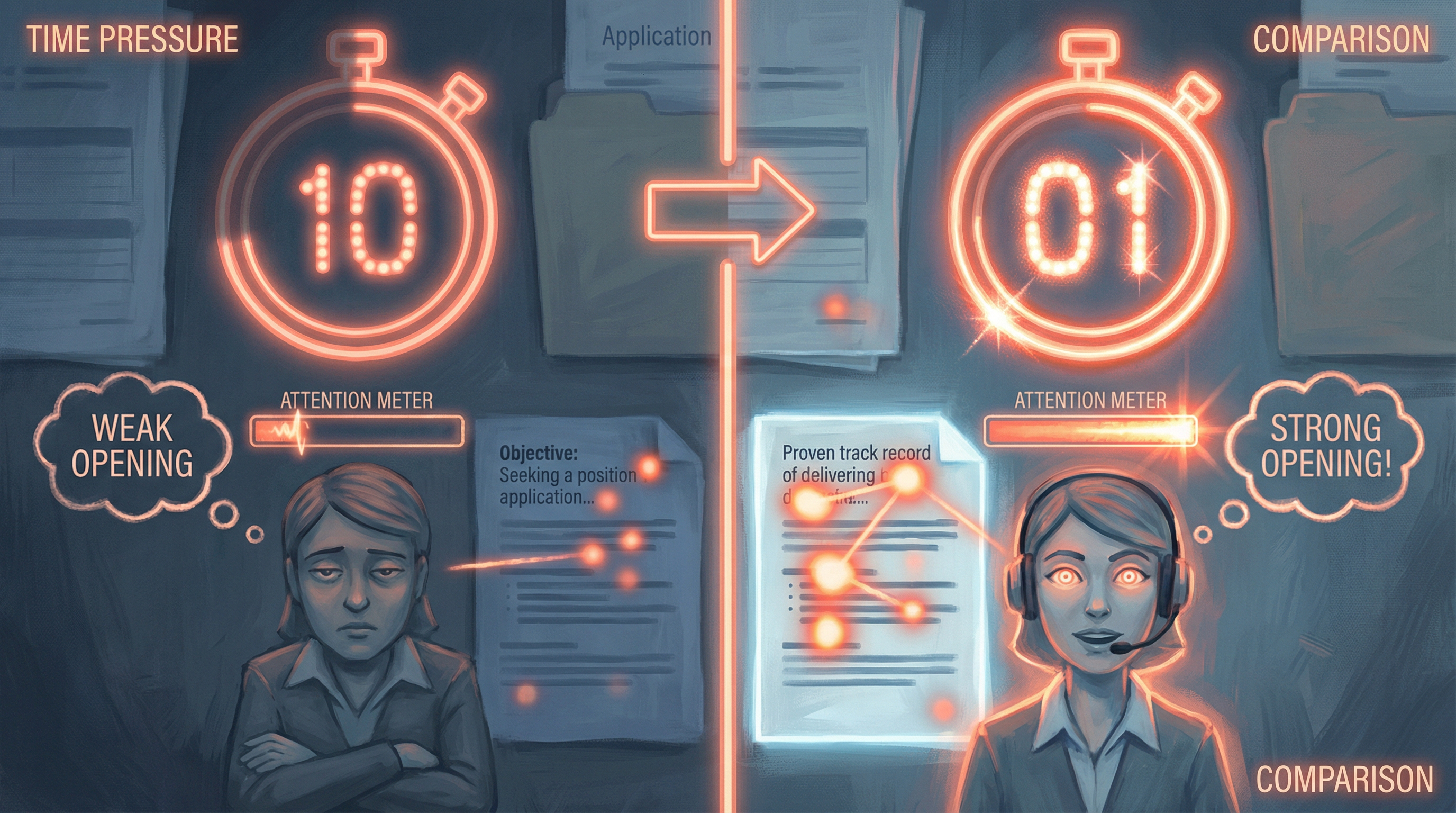
The 10-Second Rule
Research shows that hiring managers form an initial impression of your cover letter within 7-10 seconds. That's barely enough time to read your opening paragraph.
If your first sentence doesn't immediately signal value, relevance, or differentiation, they're already mentally moving to the next candidate.
What happens in those critical 10 seconds:
- ✅ Strong opening: Recruiter thinks "This is different" → Reads the full letter → Remembers you during resume review
- ❌ Weak opening: Recruiter thinks "Same as everyone else" → Skims the rest → Forgets you immediately
The Data Behind First Impressions
83% of hiring managers read cover letters even when optional, but here's what they're actually looking for in those first few sentences:
| What Hiring Managers Want in Opening Lines | Percentage |
|---|---|
| Specific connection to the role | 42% |
| Relevant achievement or credential | 31% |
| Evidence of company research | 27% |
| Authentic personality | 19% |
| Problem-solving mindset | 16% |
| Generic enthusiasm | 9% |
Notice what's at the bottom? Generic enthusiasm. Yet that's exactly what most cover letters lead with.
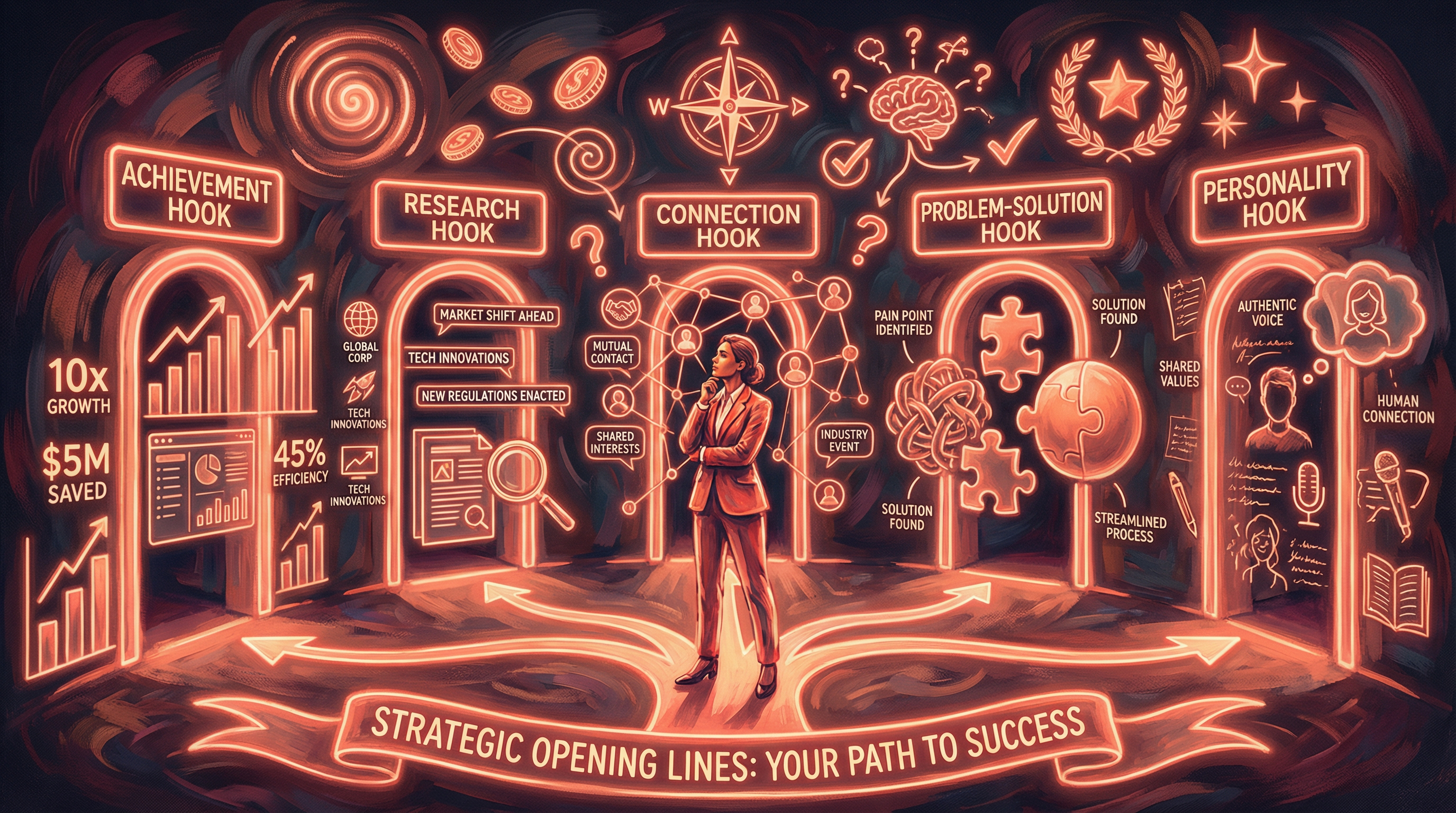
The 5 Types of Opening Lines That Work
 Before we dive into specific examples, understand that effective opening lines fall into five proven categories. Each works for different scenarios and personality types.
Type 1: The Achievement Hook
What it is: Lead with a specific, impressive accomplishment that's directly relevant to the role.
Why it works: Immediately demonstrates credibility and value. Shows you can deliver results.
Best for: Senior roles, competitive positions, when you have quantifiable achievements
Template: "In [timeframe], I [specific achievement with metric] at [company/context]—an experience that's directly applicable to [company]'s challenge with [specific issue]."
Type 2: The Research Hook
What it is: Reference specific company news, products, initiatives, or challenges that most applicants wouldn't know.
Why it works: Proves you've done your homework. Shows genuine interest beyond the job posting.
Best for: Smaller companies, startups, roles requiring strategic thinking
Template: "When I read about [specific company initiative/news], I immediately recognized [connection to your experience/skills]."
Type 3: The Connection Hook
What it is: Mention a referral, mutual connection, or shared experience with the company.
Why it works: Leverages social proof and network effects. Gets you past the "stranger" barrier.
Best for: When you have a genuine connection, networking referrals, industry events
Template: "[Name] suggested I reach out about [role] after we discussed [specific topic/challenge]."
Type 4: The Problem-Solution Hook
What it is: Identify a challenge the company faces and immediately position yourself as the solution.
Why it works: Shows strategic thinking and demonstrates you understand their business.
Best for: Product roles, consulting, strategic positions, growth-stage companies
Template: "I noticed [company] is facing [specific challenge]. Having solved this exact problem at [previous company] with [result], I can help you [outcome]."
Type 5: The Personality Hook
What it is: Lead with authentic voice, relevant personal story, or creative angle that showcases who you are.
Why it works: Differentiates you in creative fields. Shows cultural fit for personality-driven companies.
Best for: Creative roles, startups, marketing, companies with distinctive cultures
Template: "[Unique personal story/perspective] is why I'm confident I can [specific value you bring to the role]."
When using this approach, selecting the right adjectives to describe yourself matters. Our guide on 150+ words to describe yourself can help you choose traits that resonate with hiring managers.
18 Proven Opening Lines (With When to Use Each)
Achievement-Based Openers
Example 1: The Metrics Leader
"In my last role, I increased email conversion rates by 47% in six months using A/B testing and behavioral segmentation—exactly the growth marketing expertise your job posting emphasizes."
When to use: When you have impressive, quantifiable results directly relevant to the job description.
Why it works: Leads with proof. Numbers are memorable. Shows immediate ROI potential.
Example 2: The Problem Solver
"I've built three SaaS products from concept to $1M+ ARR, navigating the exact product-market fit challenges I see [Company] addressing in your Series B growth stage."
When to use: When your track record mirrors the company's current challenges.
Why it works: Demonstrates pattern recognition and proven ability to succeed in their specific context.
Example 3: The Award Winner
"After leading the campaign that won [Specific Award] for [Company], I've been looking for my next opportunity to create work that moves metrics and wins recognition—which is why your Creative Director role caught my attention."
When to use: When you have industry recognition, awards, or notable achievements.
Why it works: Third-party validation is powerful. Shows you're already recognized as excellent.
Research-Based Openers
Example 4: The Company Intel
"Your recent acquisition of [Company] signals a major push into enterprise customers—a transition I successfully led at [Previous Company], where we scaled from SMB to landing three Fortune 500 clients in 18 months."
When to use: When the company has recent news, funding, acquisitions, or strategic shifts.
Why it works: Shows you're following their trajectory. Connects your experience to their current needs.
How to find this intel: Company blog, press releases, LinkedIn posts, industry news, Crunchbase
Example 5: The Product Enthusiast
"I've been using [Company Product] for the past year and recently recommended it to my entire team at [Current Company]—so when I saw you're hiring a Customer Success Manager, I knew I had to apply."
When to use: When you're genuinely a user of their product/service.
Why it works: Authentic enthusiasm beats generic excitement. Shows you understand their product from the customer perspective.
⚠️ Warning: Only use if genuinely true. Hiring managers will ask follow-up questions.
Example 6: The Strategic Observer
"I noticed [Company]'s recent blog post about scaling customer onboarding mentioned reducing time-to-value—the exact challenge I solved at [Previous Company] by redesigning our activation flow and cutting onboarding time by 40%."
When to use: When you find specific pain points mentioned in their content marketing, blog, or thought leadership.
Why it works: Ultra-specific research. Shows you understand their challenges at a granular level.
Connection-Based Openers
Example 7: The Warm Referral
"Sarah Johnson, your Head of Product, suggested I apply for this Product Manager role after we collaborated on a panel at ProductCon last month."
When to use: When you have a legitimate internal referral or connection.
Why it works: Immediate credibility. Gets past the "cold applicant" filter.
Pro tip: Always ask permission before name-dropping someone.
Example 8: The Event Connection
"After hearing your CEO speak at [Conference] about [Company]'s approach to [topic], I've been following your growth closely—which is why I'm excited to apply for this Strategic Finance role."
When to use: When you attended an event, webinar, or conference where company representatives spoke.
Why it works: Shows proactive engagement with their thought leadership.
Example 9: The Industry Insider
"As a long-time member of the [Industry Association/Community], I've watched [Company] emerge as the leader in [specific niche]—and I'm ready to bring my 8 years of experience to help accelerate that momentum."
When to use: When you share industry communities, associations, or networks.
Why it works: Establishes insider status and shared professional context.
Problem-Solution Openers
Example 10: The Trend Spotter
"With remote hiring becoming permanent for most tech companies, I noticed [Company] is scaling distributed recruiting—a challenge I solved at [Previous Company] where I built a remote hiring process that reduced time-to-hire by 35% while improving retention."
When to use: When you can identify a trend affecting the company and position yourself as the solution.
Why it works: Shows strategic thinking and business acumen.
Example 11: The Pain Point Identifier
"Growing from 50 to 200 employees in 12 months creates inevitable HR infrastructure challenges—I know because I've built the people operations systems for two high-growth startups through this exact scaling phase."
When to use: When you understand the typical challenges their company stage faces.
Why it works: Demonstrates experience with their specific context, not just generic skills.
Example 12: The Direct Solver
"You need someone who can manage complex, multi-stakeholder projects without hand-holding. In my current role, I coordinate 15+ cross-functional teams across three time zones while maintaining a 98% on-time delivery rate."
When to use: When the job description clearly articulates a specific pain point or challenge.
Why it works: Immediately addresses their core need. No fluff, just solution.
Personality-Based Openers
Example 13: The Authentic Storyteller
"I learned to code at 10 by hacking together my own video game levels—that same curiosity-driven problem-solving is why I'm consistently the first person on my team to master new frameworks and tools."
When to use: Creative roles, startups, companies emphasizing culture fit.
Why it works: Memorable, human, shows long-term passion (not just a recent career choice).
Example 14: The Bold Statement
"Most content marketing is boring, forgettable, and doesn't convert. Mine increased organic traffic by 240% and generated $2M in attributed revenue last year."
When to use: Creative fields, marketing, when applying to companies with bold, distinctive brands.
Why it works: Confidence combined with proof. Matches energy with companies that value edge.
⚠️ Use carefully: This only works if your personality truly matches the company culture.
Example 15: The Career Definer
"I've spent my entire career at the intersection of healthcare and technology because I'm convinced software can save lives—which is why [Company]'s mission to [specific mission] resonates so deeply."
When to use: Mission-driven companies, non-profits, healthcare, education, social impact roles.
Why it works: Shows values alignment. Mission-driven companies prioritize culture fit.
Industry-Transition Openers
Example 16: The Career Changer
"After seven years teaching high school English, I'm ready to transition into corporate training—and my track record of improving student test scores by 30% through curriculum redesign proves I can create learning experiences that deliver measurable results."
When to use: Career changes where skills are transferable but the transition isn't obvious.
Why it works: Acknowledges the change directly, then immediately proves transferable value.
Example 17: The Returning Professional
"I'm returning to full-time marketing after an 18-month sabbatical caring for family—during which I maintained my skills through freelance projects and completed certifications in Google Analytics 4 and HubSpot Marketing Hub."
When to use: Explaining employment gaps while demonstrating continued professional development.
Why it works: Addresses the gap proactively, shows you stayed current, signals commitment.
Example 18: The Geographic Connector
"I'm relocating to Austin in March to be closer to family, and I've been strategically identifying the city's top SaaS companies—which is how I discovered [Company]'s impressive growth trajectory and this Sales Director opportunity."
When to use: When applying to jobs in a different city, especially if it might raise questions.
Why it works: Explains the "why now" and "why here" before they wonder about it.
The Opening Lines That Always Fail (And Why)
Understanding what works means recognizing what definitively doesn't. Here are the opening lines that make recruiters' eyes glaze over:
❌ The Generic Applier
Bad Example:
"I am writing to express my interest in the Marketing Manager position at your company."
Why it fails:
- Could apply to literally any company and any role
- Uses outdated, formal language ("I am writing to express...")
- Wastes the most valuable sentence with zero information
- Signals you're mass-applying with minimal customization
Data: Only 9% of hiring managers care about generic statements of interest.
❌ The Obvious Statement
Bad Example:
"I saw your job posting on LinkedIn and believe I would be a great fit for this role."
Why it fails:
- Obviously you saw the posting—how else would you be applying?
- "Believe I would be a great fit" is unsubstantiated opinion, not proof
- Focuses on you ("I believe") instead of them (what you can deliver)
❌ The Buzzword Bingo
Bad Example:
"As a passionate, results-driven self-starter with proven leadership skills and a track record of thinking outside the box, I'm excited to leverage my core competencies to drive synergistic solutions."
Why it fails:
- 80% of hiring managers react negatively to AI-generated buzzword language (unlike generic tools, CareerBoom's specialized AI is designed to avoid these clichés by focusing on your unique achievements).
- Every single phrase is a cliché: passionate, results-driven, self-starter, thinking outside the box, leverage, synergistic
- Says nothing specific about what you've actually accomplished
- Sounds like ChatGPT with no human editing
❌ The Resume Repeat
Bad Example:
"I am a marketing professional with five years of experience in digital marketing, including social media, email campaigns, and content creation."
Why it fails:
- This information is already on your resume
- No differentiation—thousands of applicants could write this
- Lists responsibilities, not achievements
- Doesn't explain why you're applying to this specific company
❌ The Desperate Plea
Bad Example:
"I know I don't have all the qualifications listed, but I'm a fast learner and would really appreciate the opportunity to prove myself."
Why it fails:
- Leads with what you lack, not what you bring
- "Really appreciate the opportunity" sounds desperate
- Undermines confidence before they've even considered you
- Hiring managers want solutions, not projects to mentor
Better approach: Focus on what you do have. If you're missing one requirement but strong in others, lead with strength.
❌ The Flattery Overload
Bad Example:
"Your company is the industry leader and has an amazing reputation. I've always dreamed of working for such an innovative and forward-thinking organization."
Why it fails:
- Generic praise that could apply to any company
- "Always dreamed" sounds insincere (if true, why are you applying now?)
- "Amazing," "innovative," "forward-thinking" are empty without specifics
- Focuses on what they can do for you (fulfill your dream) vs. what you can do for them
How to Craft Your Own Attention-Grabbing Opening
Can't find an exact template that fits? Here's your step-by-step formula for creating a custom opening line:
Step 1: Research the Company (15 Minutes)
Before writing a single word, gather intelligence:
Sources to check:
- Company blog and recent posts
- LinkedIn company page updates
- Recent press releases or news coverage
- Glassdoor reviews (especially "pros" section)
- The "About Us" page for mission/values
- Product updates or release notes
- Leadership LinkedIn profiles and recent posts
What you're looking for:
- Recent achievements, funding, expansions
- Challenges they're facing (hiring for your role is often a signal)
- Company values and culture signals
- Specific projects or initiatives
- Industry trends affecting them
Time investment: 15 minutes of research can differentiate you from 80% of applicants who only read the job description. (Or use CareerBoom's AI to automatically generate personalized cover letters that incorporate company research and match your profile to the role.)
Step 2: Analyze the Job Description
Read it three times. Seriously.
First read: General understanding Second read: Identify the 2-3 most emphasized requirements Third read: Note specific language, phrases, and keywords they use
Look for clues like:
- Requirements listed first (usually most important)
- Skills mentioned multiple times
- "Must have" vs. "nice to have"
- Specific tools, methodologies, or frameworks
- Pain points hinted at ("ability to work in fast-paced environment" = they're overwhelmed)
Step 3: Match Your Best Achievement to Their Top Need
Create a simple two-column comparison:
| Their Top Need (from JD) | Your Matching Achievement |
|---|---|
| "Scale customer success team" | Built CS team from 3 to 20 people |
| "Improve customer retention" | Increased retention by 35% |
| "Data-driven decision making" | Created analytics dashboard that... |
Choose the match with:
- The strongest relevance to role requirements
- The most impressive quantifiable result
- The most recent/current experience (recency matters)
Step 4: Write Your Opening Using This Formula
FORMULA: [Specific achievement/credential] + [Connection to their need/company] + [Transition to why you're applying]
Example construction:
"In my current role, I [specific achievement with metric] by [method you used]—[transition that connects to their company/challenge]."
Concrete example:
"In my current role, I reduced customer churn by 32% in eight months by implementing a predictive analytics model—an approach that would directly address the retention challenges mentioned in your Growth Product Manager job description."
Breaking it down:
- Achievement: "reduced customer churn by 32%"
- Method: "predictive analytics model"
- Connection: "retention challenges mentioned in your job description"
Step 5: Test Your Opening
Before finalizing, run it through this checklist:
✅ Is it specific to this company/role? (Could it apply to anyone else? If yes, rewrite) ✅ Does it include a concrete metric or achievement? (Numbers are memorable) ✅ Would I keep reading after this sentence? (If no, start over) ✅ Does it sound like me, not a robot? (Read it aloud) ✅ Is it under 40 words? (Brevity keeps attention—learn more in our guide on how long a cover letter should be) ✅ Does it avoid clichés and buzzwords? (No "passionate self-starter")
Industry-Specific Opening Line Strategies
Different industries have different expectations. Here's how to calibrate your opening for maximum impact:
Tech & Startups
What works:
- Metrics and growth numbers
- Product knowledge or user experience
- Technical credibility (specific tools, frameworks)
- Speed and scrappiness
Example:
"I built my first profitable side project at 19, scaled it to 10K users, and sold it two years later—that same entrepreneurial, builder mindset is why I'm drawn to [Startup]'s early-stage chaos."
What to avoid: Overly formal language, corporate jargon
Finance & Consulting
What works:
- Quantifiable business impact
- Strategic thinking demonstrated
- Prestigious firms or clients name-dropped (if applicable)
- Professional, polished language
Example:
"At [Previous Firm], I led the financial due diligence for three M&A transactions totaling $400M, uncovering cost synergies that increased deal value by an average of 12%."
What to avoid: Casual tone, unsubstantiated claims
Creative Fields (Marketing, Design, Content)
What works:
- Personality and voice
- Portfolio achievements
- Creative angles
- Cultural fit signals
Example:
"I turn boring B2B software into content people actually want to read—which is how I grew [Company]'s blog from 5K to 150K monthly readers in 18 months while generating $3M in pipeline."
What to avoid: Generic corporate speak, overly buttoned-up language
Healthcare & Education
What works:
- Mission alignment
- Patient/student outcomes
- Compliance and quality credentials
- Empathy and care
Example:
"Improving patient outcomes through better care coordination isn't just my job—it's why I chose healthcare. At [Hospital], I redesigned our discharge process to reduce 30-day readmissions by 28%."
What to avoid: Purely profit-driven language, ignoring mission
Non-Profit & Social Impact
What works:
- Values alignment and mission connection
- Impact metrics (lives changed, not just dollars)
- Long-term commitment signals
- Community understanding
Example:
"I've volunteered with literacy programs for seven years because I believe reading access is a civil rights issue—which is why [Organization]'s mission to increase book access in underserved communities resonates so deeply."
What to avoid: Purely transactional language, ignoring mission
Advanced Techniques: Taking It to the Next Level
Once you've mastered the fundamentals, these advanced techniques can give you an even stronger edge:
Technique 1: The Pattern Interrupt
What it is: Start with something unexpected that breaks the monotony of application reading.
Example:
"I've been rejected by 47 companies in my job search so far. But this application is different because [Company]'s approach to [specific thing] is exactly what I've been looking for."
Why it works: The honesty and vulnerability are disarming. The specificity of "47" makes it memorable.
⚠️ Use carefully: Only for creative roles or companies with unconventional cultures. This would backfire in conservative industries.
Technique 2: The Question Hook
What it is: Open with a thought-provoking question that sets up your value proposition.
Example:
"What's the difference between customer service and customer success? At [Previous Company], I redefined that distinction, transforming our reactive support model into a proactive success program that increased customer lifetime value by 55%."
Why it works: Questions create curiosity and engagement. The immediate answer shows you're not just asking—you're providing solutions.
When to use: Strategy roles, consulting, thought leadership positions
Technique 3: The Contrarian Take
What it is: Challenge conventional wisdom, then back it up with your experience.
Example:
"Most marketers think brand awareness comes before demand generation. I've proven the opposite: at [Company], I focused exclusively on bottom-funnel conversions first, which paradoxically increased branded search volume by 180% within six months."
Why it works: Shows independent thinking and confidence. Memorable because it challenges assumptions.
When to use: Senior roles, strategy positions, innovative companies
⚠️ Risk: Only use if you can back it up with solid proof. Controversial without substance is just annoying.
Technique 4: The Hyper-Local Reference
What it is: Reference something ultra-specific to their company that shows deep research.
Example:
"I read your CTO's recent blog post about migrating from monolith to microservices—I led that exact architecture transition at [Company], reducing deployment time from 4 hours to 12 minutes while improving system reliability."
Why it works: Shows you've gone beyond the job posting to understand their technical challenges and thought leadership.
Where to find material:
- Company engineering blog
- Leadership LinkedIn posts
- Conference talks by employees
- GitHub repositories
- Technical documentation
Common Opening Line Mistakes (And How to Fix Them)
Mistake 1: The "Everyone" Opener
The problem:
"Everyone says I'm a natural leader with great communication skills..."
Why it fails: Vague, unsubstantiated, relies on unnamed sources
The fix:
"I've led five cross-functional teams through complex product launches, including [specific example], which shipped on time and 15% under budget."
Lesson: Replace opinions with specific evidence.
Mistake 2: The Over-Explainer
The problem:
"After carefully reviewing your job posting for the Marketing Manager position, which I found very interesting and well-aligned with my background and career goals, I am excited to submit my application for your consideration."
Why it fails:
- 40 words to say almost nothing
- Wastes precious attention with filler
- Focuses on process ("I reviewed," "I am submitting") instead of value
The fix:
"I've grown three SaaS companies' organic traffic to 100K+ monthly visitors—growth marketing expertise that directly matches your scaling goals."
Lesson: Cut everything that doesn't add value. Get to the point.
Mistake 3: The False Modesty
The problem:
"While I may not have every qualification you're looking for, I believe my enthusiasm and willingness to learn make up for any gaps."
Why it fails:
- Leads with weakness
- "Enthusiasm" isn't a qualification
- Sounds like you're asking for a favor
The fix:
"My three years in digital marketing have delivered measurable results: 40% increase in conversion rates, 2x email engagement, and $500K in attributed revenue."
Lesson: Lead with strength, always. If you're light on experience, emphasize the impressive results you have achieved.
Mistake 4: The Jargon Overload
The problem:
"As a synergy-focused, results-oriented professional leveraging cutting-edge best practices to drive value-added solutions across stakeholder ecosystems..."
Why it fails:
- Buzzword soup with no meaning
- Doesn't communicate anything specific
- Sounds like AI without human editing
The fix:
"At [Company], I coordinated 12 departments to launch our new product 6 weeks ahead of schedule, generating $2M in first-quarter revenue."
Lesson: Specific beats abstract. Always.
Real Cover Letter Openers That Got Results
Let's look at actual opening lines (adapted to protect identity) that led to interview invitations:
Example A: Product Manager at a Fintech Startup
Opening line:
"I noticed [Company] recently raised Series B to expand into embedded finance—a space I helped pioneer at [Previous Company], where I launched our first Banking-as-a-Service product and scaled it to $8M ARR in 14 months."
Result: Interview within 48 hours
Why it worked: Hyper-specific company knowledge (Series B, embedded finance focus) + directly relevant experience + impressive metric.
Example B: Content Marketing Manager at SaaS Company
Opening line:
"I've been a paying customer of [Product] for two years, so when I saw you're hiring a Content Marketing Manager to grow organic traffic, I knew I had to apply—especially since I grew my current company's blog from 12K to 200K monthly visitors using the exact SEO strategies that would work for your product."
Result: Phone screen within a week
Why it worked: Genuine product knowledge + clear proof of relevant success + specific plan.
Example C: Senior Designer at a Non-Profit
Opening line:
"Design for social impact isn't a side project for me—it's been my career focus for eight years. At [Previous Org], I redesigned our donor experience to be more accessible and emotionally resonant, increasing online donations by 67% while making the experience work for users with visual impairments."
Result: Interview and eventual job offer
Why it worked: Values alignment + specific achievement + demonstrates thoughtfulness (accessibility).
Frequently Asked Questions
Should my opening line mention the exact job title?
Not necessarily. It's more important to demonstrate relevance than to formally state "I'm applying for the Senior Product Manager position."
Weak: "I am applying for your Senior Product Manager position." Strong: "I've shipped three B2B SaaS products from concept to profitability—experience that directly aligns with your Series B product expansion."
The second version makes it obvious you're applying for a PM role without wasting words stating it.
How personal should I get in my opening?
It depends on the company culture.
Conservative industries (finance, law, healthcare): Keep it professional. Lead with achievements. Creative/startup cultures: Personality can work, but ensure it's backed by substance.
Rule of thumb: Personality should enhance your credibility, not replace it.
Can I use humor in my opening line?
Very carefully. Humor can backfire spectacularly if misread or if it doesn't match company culture.
When it can work:
- Creative agencies
- Startups with playful brands
- Roles requiring personality (sales, marketing, community)
When to avoid:
- Corporate environments
- Senior/executive positions
- Conservative industries
Safe humor example:
"I've been called a data nerd, spreadsheet enthusiast, and 'the person who actually enjoys pivot tables'—which is why I'm excited about your Financial Analyst role."
This is self-deprecating and specific to the role, not random comedy.
What if I don't have impressive metrics to lead with?
Focus on one of these instead:
-
Specific skills: "I'm fluent in React, TypeScript, and Node.js, with particular expertise in building accessible, performant front-end applications."
-
Relevant projects: "I recently built a full-stack e-commerce platform as a capstone project that processes real payments and includes an admin dashboard—experience directly applicable to your Junior Developer role."
-
Transferable experience: "After three years managing a team of 12 restaurant staff through high-pressure dinner services, I've mastered the coordination and communication skills essential for project management."
Metrics are ideal, but specificity and relevance work too.
Should I always customize my opening line for every application?
Yes, if you want the best results.
The math:
- 5 applications with customized openers: 40-50% response rate
- 20 applications with generic openers: 5-10% response rate
Quality beats quantity. Better to send fewer applications with strong, tailored opening lines than to spray generic letters everywhere. (If you're short on time, CareerBoom's AI can handle the tailoring process for you in seconds.)
Conclusion: Your Opening Line Is Your First Impression
Remember: Hiring managers spend 30 seconds on your cover letter. Your opening line determines whether those 30 seconds turn into 3 minutes of engaged reading or an immediate click to the next applicant.
The difference between "I am writing to express my interest..." and "I grew organic traffic by 240% using the SEO strategies that would work perfectly for your product" is the difference between being forgotten and being remembered.
Your action plan:
- Research the company for 15 minutes (find specific, recent information)
- Identify your best achievement that matches their needs
- Draft 3 opening line variations using the templates in this guide
- Test them using the 8-point checklist above
- Select the strongest and refine it
- Connect it smoothly to your second paragraph
Or, save time and let AI do the heavy lifting: CareerBoom analyzes your profile and the job description to automatically generate compelling, personalized cover letters with opening lines designed to hook recruiters. No more staring at a blank page—get a professionally crafted cover letter in minutes.
Most applicants will open with: "I am excited to apply for this position..."
You will open with: Specific achievements, company knowledge, and immediate proof you can deliver value.
That difference? It's the difference between getting noticed and getting hired.
Ready to write your opening line? Use the 18 examples and templates above as your starting point, customize for your situation, and watch your response rate climb.
The recruiter is waiting. Make that first sentence count.
Was this article helpful?
Table of Contents
Why Your Opening Line Is Make-or-Break
The 5 Types of Opening Lines That Work
18 Proven Opening Lines (With When to Use Each)
The Opening Lines That Always Fail (And Why)
How to Craft Your Own Attention-Grabbing Opening
Industry-Specific Opening Line Strategies
Advanced Techniques: Taking It to the Next Level
Common Opening Line Mistakes (And How to Fix Them)
Real Cover Letter Openers That Got Results
Frequently Asked Questions
Conclusion: Your Opening Line Is Your First Impression
Share this article
Other articles
How to Write a Cover Letter That Actually Gets Read
Your guide to writing cover letters that get noticed by recruiters and beat the ATS.
Do You Really Need a Cover Letter? (+ When to Skip It in 2026)
The definitive answer to whether cover letters still matter—plus the exact scenarios when you can skip them without hurting your chances.
How Long Should A Cover Letter Be in 2026? (The Definitive Guide)
Stop writing essays. Discover the perfect word count for email and attached cover letters to get more interviews.