How to Explain Employment Gaps in Resumes: The 2026 Guide
Turn career breaks into strengths with our comprehensive guide for 2026
8 months ago

Employment gaps are no longer career-ending obstacles. Recent data reveals that over 68% of workers have experienced employment gaps, and as of 2025, fewer than 50% of job seekers maintain uninterrupted employment histories. The traditional "continuous employment" model is becoming a relic of the past.
📊 Key Stat: 91% of employers identify skill gaps—not employment gaps—as their primary hiring obstacle.
This means recruiters care less about time away from work and far more about whether your skills are current and how you've used your time productively.
Whether you took time off for caregiving, traveling, upskilling, health, relocation, or were affected by layoffs, this guide shows you how to explain a gap in a way that is honest, ATS-friendly, and interview-ready.
🤔 Before You Explain Anything: Do You Even Need to Address the Gap?
Use this quick rule of thumb:
| Gap Length | Action Required |
|---|---|
| Under 3 months | Often not worth calling out on resume (be ready to explain if asked) |
| 3–12 months | Consider a light explanation only if recent and obvious |
| 12+ months | Usually worth adding a "Career Break" entry, especially within past 5–7 years |
| Multiple gaps | Use structure to reduce scrutiny (skills-first + grouped consulting + year-only dates) |
📈 The Shift in 2026: Why Gaps Are Normalizing
The job market in 2026 continues to evolve with slower hiring in some sectors but strong demand for skilled professionals in healthcare, AI, and green technologies. Gaps due to layoffs, family responsibilities, or upskilling are viewed more favorably than in previous years.
💡 Success Factor: Candidates who proactively explain their gaps and demonstrate growth receive up to 60% more interviews.
The key? Honesty, positivity, and framing the gap as a period of development.
Recruiters in 2026 are looking for capability, current skills, and reliability—not a perfect timeline.
While 60% of hiring managers historically viewed gaps negatively, the underlying concern has changed. Approximately 50% of hiring managers cite applicants lacking relevant experience as their primary hiring challenge, up from 45% the prior year. This means your narrative around employment gaps should emphasize what skills and knowledge you gained, not why you left.
What Recruiters Really Care About:
- ✅ Are your skills current? Have you stayed engaged with industry developments?
- ✅ Are you available and ready now? Is there anything preventing you from starting?
- ✅ Can you communicate professionally about difficult topics? Your gap explanation is a test of your communication skills.
📋 Common Reasons for Employment Gaps (Quick Reference)
Employment gaps happen for valid reasons. Here's how to frame the most common ones positively:
| Reason | How to Frame It | Impact |
|---|---|---|
| Layoffs/Restructuring | "Position eliminated due to company restructuring; used time to pursue certifications in [relevant skill]" | ⭐⭐⭐ Strong |
| Family/Caregiving | "Took a planned sabbatical to care for family; developed project management and resilience skills" | ⭐⭐⭐ Strong |
| Health/Personal | "Focused on personal health and well-being; now fully energized to return" | ⭐⭐ Neutral |
| Education/Upskilling | "Completed advanced training in AI and data analytics to align with emerging industry trends" | ⭐⭐⭐⭐ Very Strong |
| Travel/Sabbatical | "Intentional career break for global travel; gained cultural adaptability and problem-solving experience" | ⭐⭐⭐ Strong |
| Relocation/Transition | "Relocated for family opportunities; volunteered in [field] to maintain industry connections" | ⭐⭐⭐ Strong |
💡 Pro Tip: Always emphasize what you learned—skills like adaptability, resilience, or new technical abilities are highly valued in 2026's skills-focused hiring.
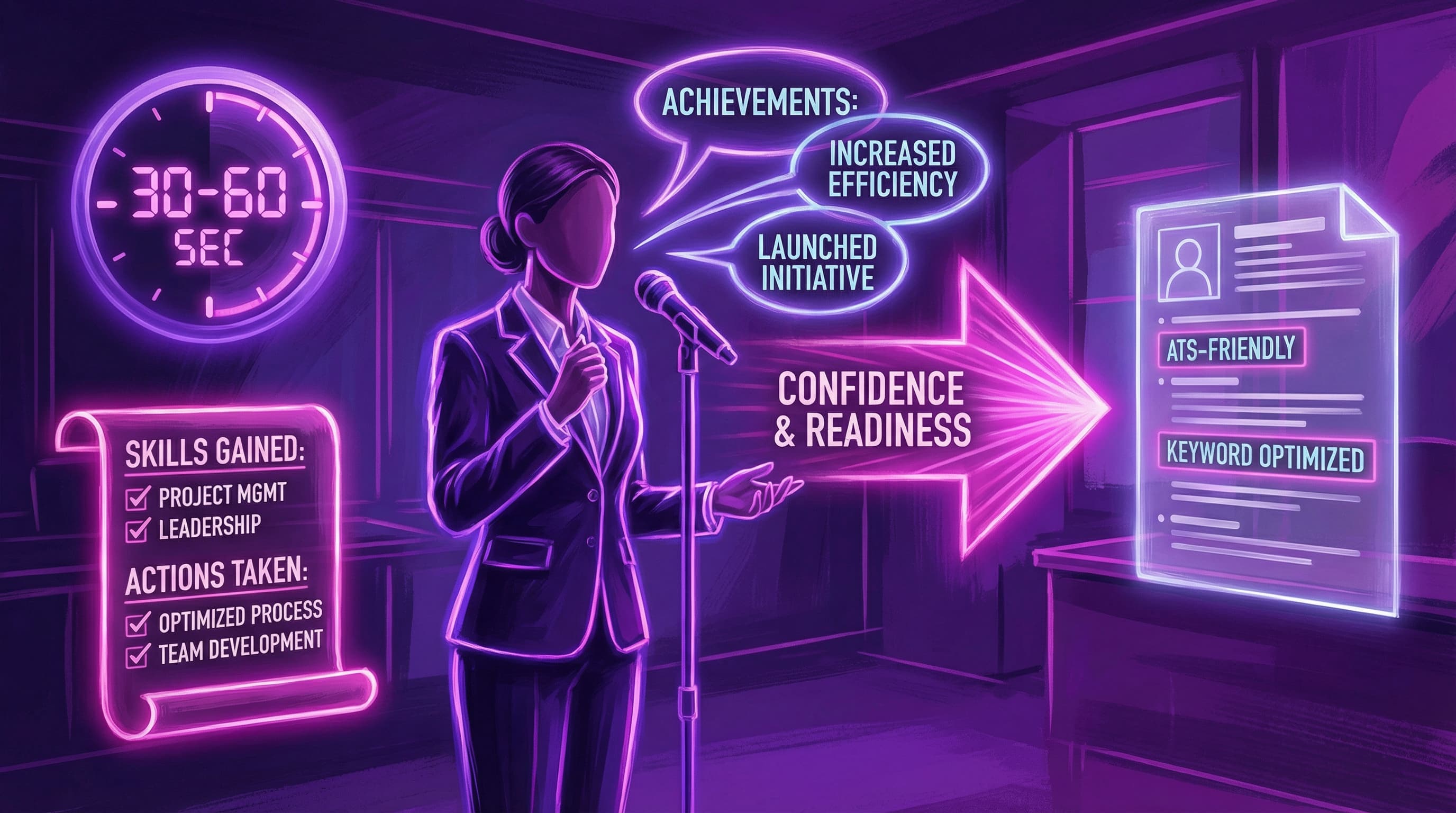
🎯 The 30–60 Second Framework Recruiters Want
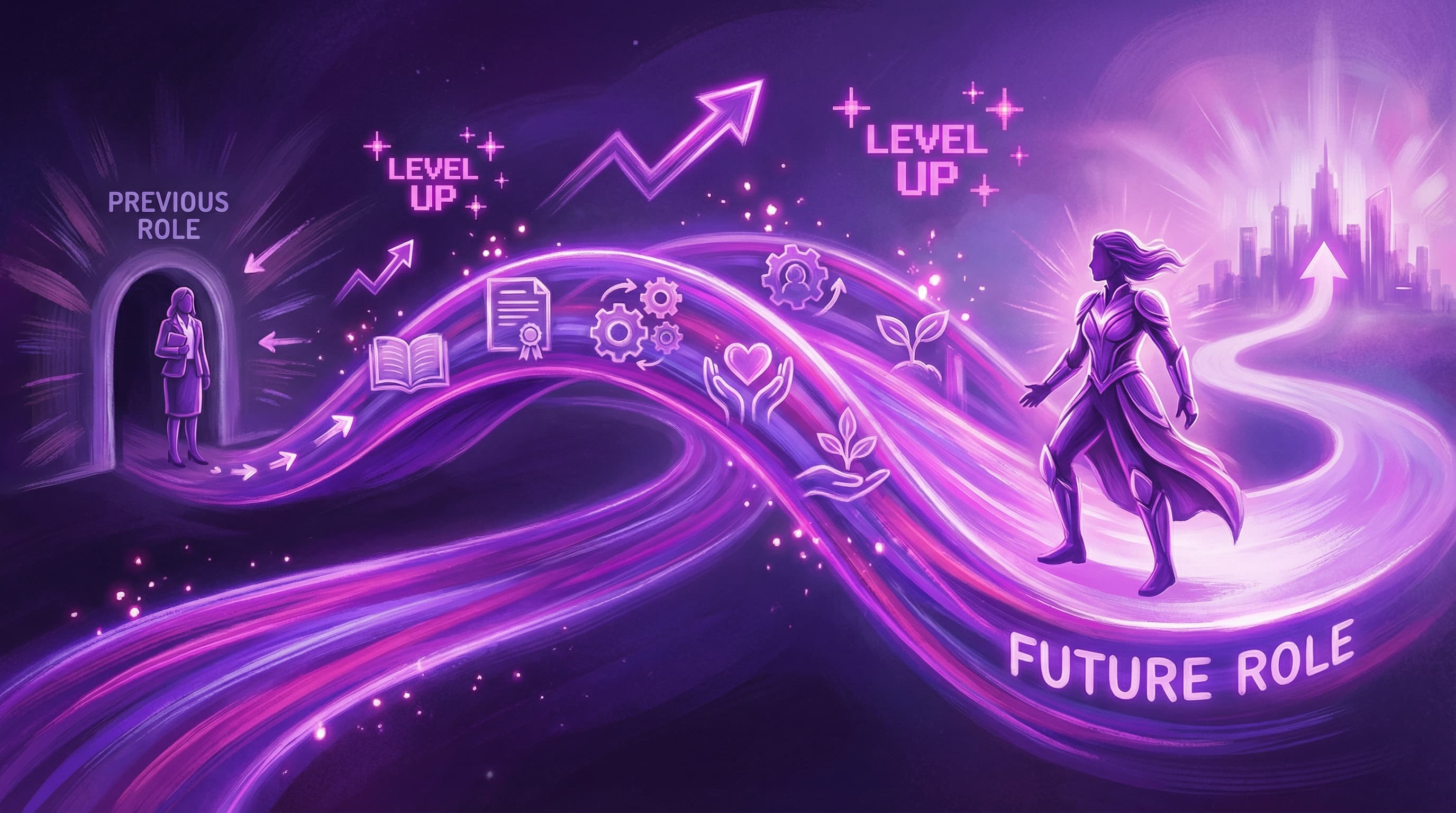
Prepare a templated response that follows this structure. It works for resumes, cover letters, and interviews:
- State the reason (factually and briefly—one line maximum)
- Describe what you did (actions taken, skills gained, projects completed, certifications earned)
- Reinforce your readiness (enthusiasm for the role, commitment to returning, forward focus)
📝 Example Script for Interviews:
"From 2023 to 2024, I took a career break to focus on professional upskilling. During that time, I completed Google's Data Analytics certification, worked on three freelance projects that strengthened my portfolio, and actively followed industry developments through webinars and networking. I'm now returning to the workforce fully energized and positioned to bring both technical expertise and demonstrated commitment to continuous learning to your team."
Why this works: It's confident, specific, concise, and forward-facing. It doesn't apologize, doesn't minimize the gap, and doesn't invite further questioning.
🛠️ Strategies to Handle Resume Gaps
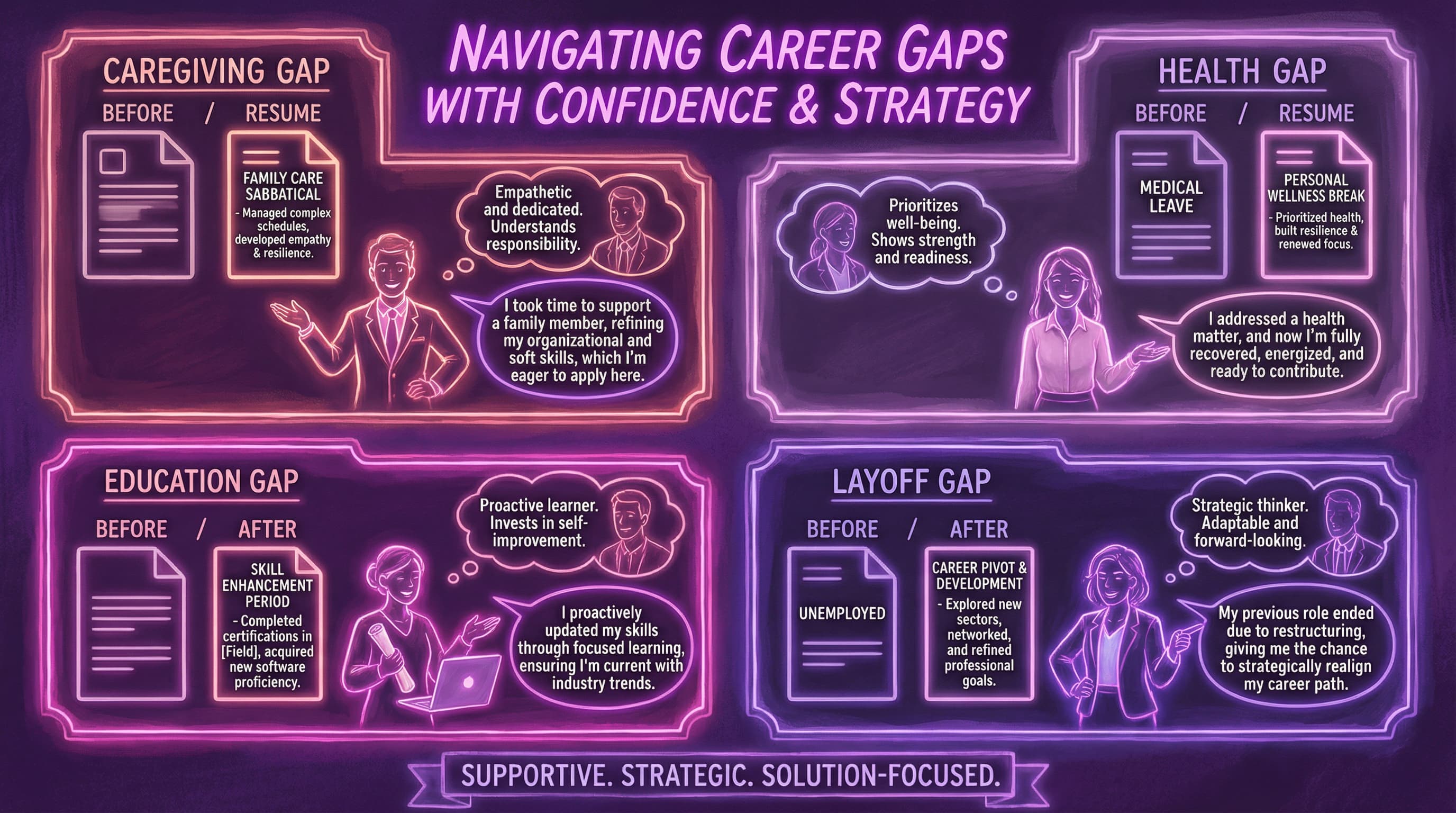
1. Be Honest and Confident
Attempting to hide a gap often draws more attention to it. If you try to "smooth dates" in a misleading way, background checks or references can expose it. Instead, own the gap with a clean, short explanation.
Good vs Bad: Gap Honesty on the Resume
❌ Bad (vague + suspicious):
"2024–2025: Personal time"
✅ Good (specific enough + professional):
"2024–2025: Career break (family caregiving) + skills refresh (Excel, SQL)"
2. Use "Years" Format for Older Gaps (When Appropriate)
If your gap was several roles ago or is short, listing by year can reduce attention on a 3–8 month break:
- Marketing Manager, TechCorp | 2023 – 2025
- Content Specialist, MediaGroup | 2020 – 2022
Good vs Bad: Date Consistency
❌ Bad (inconsistent formatting that invites scrutiny):
- Role A | Jan 2023 – Mar 2024
- Role B | 2022
✅ Good (consistent):
- Role A | 2023 – 2024
- Role B | 2021 – 2022
For more examples of formatting mistakes to avoid, including how inconsistent date formatting raises red flags, check out our article on bad resume examples and what not to do.
3. Add a "Career Break" Entry (The Most Underused Fix)
For gaps longer than a year (or shorter gaps that will be obvious), treat the break like a job entry—simple, factual, and skills-forward.
Example:
Career Break | 2024 – 2025
- Focused on full-time caregiving while maintaining readiness through weekly webinars and completing an "Advanced Project Management" certification.
📝 Copy/Paste Templates (Choose One)
Template A — Simple and Safe
Most people should use this
Career Break | 2024 – 2025
- Took time for [caregiving / health / relocation / personal]
- Maintained industry readiness through [course/certification], [project/volunteering], and regular practice in [tools]
- Ready to return full-time; targeting roles in [target role] with strengths in [2–3 skills]
Template B — Skills-Forward
Ideal for tech/product/marketing
Professional Development Sabbatical | 2024 – 2025
- Completed [certification/course] and built [project/portfolio]
- Shipped [measurable outcome] (example: "launched 3 projects; improved load time by 40%")
- Returning with refreshed skills in [tools], aligned to [job title]
Template C — Job-Search Gap
Only if you have strong activities to show
Career Transition / Job Search | 2024 – 2025
- Targeted roles in [function/industry] and completed [certification], [volunteering], and [project]
- Focused on roles like [target role] where I can apply [skills] to deliver [outcome]
⚠️ What NOT to Do (Mistakes That Trigger Doubt)
| ❌ Mistake | Why It's Bad | ✅ Do This Instead |
|---|---|---|
| Vague language ("personal reasons") | Signals evasiveness and invites scrutiny | Be specific: "caregiver," "professional development," "sabbatical" |
| Omitting gaps entirely | Makes you appear to be hiding something | Add clear dates and a brief explanation |
| Apologizing ("I realize I have a gap...") | Signals weakness and invites doubt | Use confident, factual language |
| Over-explaining (paragraph-long explanations) | Invites sympathy rather than respect | Keep to 1–2 lines on resume, 30–60 seconds in interviews |
| Functional resume only | ATS struggles + recruiter suspicion | Always include chronological work history element |
| Inventing projects/certifications | Background checks will expose this | Be honest; focus on what you're doing now |
💬 Scenarios and Scripts (With Good and Bad Answers)
Scenario A: Stay-at-Home Parent / Caregiving
This is one of the most common reasons for a resume gap. Caregiving develops measurable competencies: stakeholder management, crisis response, budget management, coordination across multiple parties, and patience under pressure.
📝 Resume Text (example):
Full-time Caregiver / Family Coordinator | 2023 – 2025
- Coordinated medical appointments and managed household budgets
- Liaised with healthcare providers and insurance companies
- Maintained professional skills through [course/project] and volunteered as Treasurer for local PTA, managing funds over $10k
Interview Answers:
❌ Bad (oversharing + uncertain):
"I was dealing with a lot at home, and it was hard. I'm not sure I'm fully back yet, but I'm trying."
✅ Good (clear + ready-now):
"I took a planned career break for full-time caregiving. During that time I kept my skills current through [course/project], and now that my schedule is stable, I'm ready to return full-time. I'm specifically targeting roles where I can apply [skill 1] and [skill 2]."
⭐ Great (adds proof + role fit):
"I took 14 months for caregiving. I stayed current by completing [certification], volunteering as [role], and building a small project in [tool]. I'm now ready to return, and this role fits because it leans heavily on [relevant responsibility]."
📧 Cover Letter Mini-Paragraph (copy/paste):
"After a planned career break for family caregiving, I'm excited to return to full-time work. During this period I maintained and sharpened my skills through [course/project], and I'm now focused on roles where I can contribute immediately in [skills]."
Scenario B: Layoffs and Unemployment
The normalization of corporate restructuring has fundamentally changed how layoffs are perceived. Technology sector layoffs in 2023–2025 eliminated thousands of skilled professionals, creating widespread understanding that layoffs reflect market conditions, not individual performance.
💡 Key Point: Be direct about the layoff itself—there's no shame and no need to hide it. What differentiates you is how you responded.
Interview Answers:
❌ Bad (bitter + blame):
"My company was a mess and leadership ruined everything. Then I couldn't find anything because the market is terrible."
✅ Good (neutral + forward):
"My role was impacted by a restructure/layoff. Since then, I've been intentional about targeting roles that match my strengths in [skills], and I used the time to [course/project]."
⭐ Great (adds measurable activity + positions you stronger):
"My position was eliminated in a company-wide restructuring in March 2024. Rather than waiting passively for opportunities, I invested the next six months in upgrading my technical skills. I completed the AWS Solutions Architect certification, worked on two cloud infrastructure projects, and expanded my network within the cloud engineering community. I'm now positioned to contribute at a higher technical level than my previous role, and I'm excited about the opportunity to bring this enhanced expertise to your team."
📝 Resume Entry (example):
Career Transition (Layoff) | 2025
- Completed [cert] and built [project] in [tools]; actively interviewing for [target role].
Scenario B2: You Were Fired (Harder, But Manageable)
Be honest, short, and focused on fit and learning.
❌ Bad (defensive + too detailed):
"They fired me for performance but it wasn't fair and my manager hated me, and I was doing 3 people's jobs."
✅ Good (short + accountable):
"That role ended because it wasn't the right fit. I took time to reflect, upskill in [skill], and I'm now focused on roles that better match my strengths in [strengths]."
⭐ Great (shows change + confidence):
"That role ended due to a mismatch in expectations. Since then, I've strengthened [skill] through [course/project], and I'm now targeting roles where I can deliver quickly in [strengths]."
Scenario C: Education and Upskilling
This is the easiest gap to explain because it's an investment—make it outcome-driven.
📝 Resume Text (example):
Sabbatical for Professional Development | 2024 – 2025
- Completed [certification] and built [portfolio/project]
- Practiced [skills] and delivered [result] (example: "created 5 React apps")
❌ Bad (sounds like stalling):
"I was studying a bit online and applying sometimes."
✅ Good (structured + outcomes):
"I took time to reskill deliberately: completed [program], built [portfolio], and practiced [skills]. I'm now ready to apply those skills in a full-time role."
Scenario D: Health or Personal Reasons
You are not required to disclose medical details. Keep it brief and ready-now.
❌ Bad (too much detail):
"I had a medical issue and it was complicated. I had surgeries, and it affected everything..."
✅ Good (minimal + resolved):
"I took time to address a personal health matter that's now resolved. I'm fully ready to return, and I'm excited to focus on [job function]."
⭐ Great (adds a return-to-work bridge):
"I took a short break for a personal health matter, which is now resolved. I've re-established my routine through [project/freelance/volunteering], and I'm ready to contribute full-time."
Scenario E: Relocation / Immigration / Visa Timelines
❌ Bad (uncertain):
"I was moving and dealing with paperwork. It took a while."
✅ Good (clear + current status):
"I relocated to [city/country] and completed the necessary administrative steps. That's now finalized, and I'm available for full-time work."
Scenario F: Burnout / Reset (Keep It Professional)
You can address this without sharing sensitive details.
❌ Bad (raises stability concerns):
"I was burned out and couldn't work. I'm hoping it won't happen again."
✅ Good (clean narrative + ready-now):
"I took a planned break to reset and reassess my goals. I'm now energized, focused, and ready to return to full-time work in [role]."
📊 Resume + Interview Examples: Same Gap, Two Different Outcomes
Example 1: 9-month gap after layoff
| Type | ❌ Bad | ✅ Good |
|---|---|---|
| Resume | 2024 – 2025: Unemployed | Career Transition (Layoff) | 2024 – 2025 - Completed [cert]; built a [project] in [tools]; actively interviewing for [role] |
| Interview | "I got laid off and then nothing really worked out." | "I was laid off during a restructure. I used the time to complete [cert] and build [project], and I'm now focused on roles where I can apply [skills]." |
Example 2: 2-year caregiving gap returning to work
| Type | ❌ Bad | ✅ Good |
|---|---|---|
| Resume | 2023–2025: Stay at home | Career Break (Family Caregiving) | 2023 – 2025 - Maintained professional readiness via [course/project]; volunteered as [role] |
| Interview | "I was just at home, so I'm probably rusty." | "I took two years for caregiving. During that time I kept my skills current through [activity], and I'm ready to return full-time now that my schedule is stable." |
Example 3: 6-month "job search only" gap
⚠️ Note: If you truly didn't do much beyond applying, don't manufacture an entry. Use clean dates and be ready to explain briefly in interviews.
🎤 Interview Mastery: Handling the Gap Question with Confidence
Employment gap questions in interviews are virtually inevitable. Preparation eliminates anxiety and demonstrates confidence—the two most critical ingredients in successfully navigating this topic.
The Redirect Technique
After delivering your 30–60 second gap explanation, take control by asking a specific question about the role. This prevents follow-up probing and demonstrates genuine interest.
Example:
"...and I'm particularly excited about this position because I see the opportunity to apply my new data skills to your customer analytics function. Can you tell me more about how your team approaches data-driven decision-making?"
Common Follow-Up Questions (And How to Handle Them)
| Question | How to Answer |
|---|---|
| "What industry trends did you follow during your time away?" | Reference specific publications, webinars, conferences, or online communities you engaged with. Be specific with names and topics. |
| "How have your skills evolved?" | Highlight certifications, projects, volunteer work, or self-directed learning. Quantify where possible. |
| "Are you confident you can jump back in?" | Emphasize your excitement, recent engagement with your field, and specific projects you're prepared to undertake. Show readiness, not hesitation. |
🤖 ATS Optimization for Employment Gaps
Modern Applicant Tracking Systems can penalize unexplained gaps by downranking your resume. Never leave a gap unaccounted for.
Three Essential Elements for Every Gap Entry:
- ✅ Clear title: "Professional Development," "Family Caregiver," "Career Transition"
- ✅ Consistent date formatting: Either months and years or years only—match the format you use for all positions
- ✅ 2–3 bullet points with keywords: Use keywords from your target job description within these bullet points to maximize ATS keyword matching
🔒 Background Check Safety
| ⚠️ Don't | ✅ Do |
|---|---|
| Change titles or dates to hide a gap | Use consistent formatting across all roles |
| Embellish or fabricate activities | Be truthful about what you did |
| Use different date formats for gaps | Match your gap format to all other positions |
📄 Resume Formatting Tips for Gaps
- Focus on skills first: Use a hybrid format with Competencies and Projects near the top
- Include volunteering: It demonstrates momentum and responsibility
- Group freelance work: If you did multiple small gigs, group them under "Freelance Consultant" to reduce fragmentation
🚀 Final Tips for Success in 2026
- 📚 Upskill Actively: Platforms like Coursera or LinkedIn Learning can fill gaps with in-demand skills (e.g., AI, cybersecurity)
- 🤝 Network: LinkedIn activity and informational interviews can bridge gaps
- 🎯 Tailor Every Application: Customize explanations to the job
- 💼 Seek Professional Help: Resume writers or career coaches can refine your approach
💡 Remember: Employment gaps don't define your career—they can highlight your resilience in a changing world. By addressing them transparently and positively, you'll stand out as a thoughtful, adaptable candidate ready for 2026 opportunities.
❓ FAQ: Employment Gaps in 2026
Should I mention the gap on my resume?
If it's long (12+ months) and recent, usually yes—add a simple "Career Break" entry. If it's short or older, you can often skip it and explain verbally if asked.
What if I did nothing during the gap?
Don't invent. Keep it short, explain neutrally, and focus on what you're doing now to return (learning plan, portfolio, volunteering, returnship).
🏆 The Competitive Advantage: Turning Your Gap Into Differentiation
In 2026, employment gaps are increasingly common, increasingly normalized, and increasingly manageable—if you address them strategically.
📊 Market Insight: 85% of hiring managers express positive outlook for 2026 hiring, but competition remains intense.
Your willingness to take an employment gap—for caregiving, upskilling, recovery, or deliberate career change—can actually set you apart if you've used that time purposefully. You've invested in yourself while others stayed in comfortable but static roles. That's a narrative worth confidently sharing. For those who took time off to transition into a completely new field, our guide on making a career change at 30, 40, or 50 provides additional strategies for pivoting successfully.
🎯 Key Takeaways for 2026
-
Normalize the gap: 68% of workers have employment gaps. You're not alone. Frame it matter-of-factly, not apologetically.
-
Focus on skills, not circumstances: Employers care less about why you left and far more about what skills you gained. Emphasize learning, certifications, projects, and competencies developed during the gap.
-
Use consistent formatting: Years-only formatting for gaps under 12 months, hybrid resume format for longer gaps. Consistency across all positions is critical.
-
Create a 30–60 second script: Prepare and practice a confident, brief explanation that covers reason, action, and readiness. This preparation eliminates hesitation in interviews.
-
Optimize for ATS: Name every gap clearly with a title, include consistent dates, and fill entries with relevant keywords from your target job description.
-
Frame in your cover letter: Address the gap briefly (2–3 sentences), focusing on accomplishments and readiness. Save the detailed explanation for interviews if asked.
-
Differentiate by demonstrating growth: Use the gap to show you're more skilled, more strategic, more thoughtful, or more committed than when you left the workforce.
📖 Conclusion
An employment gap is a chapter in your story, not the whole book. By framing your career break with clarity and focusing on your readiness to return to work, you control the narrative. In 2026, employers want to know who you are today and what you can bring to the table tomorrow.
Was this article helpful?
Table of Contents
🤔 Before You Explain Anything: Do You Even Need to Address the Gap?
📈 The Shift in 2026: Why Gaps Are Normalizing
📋 Common Reasons for Employment Gaps (Quick Reference)
🎯 The 30–60 Second Framework Recruiters Want
🛠️ Strategies to Handle Resume Gaps
📝 Copy/Paste Templates (Choose One)
⚠️ What NOT to Do (Mistakes That Trigger Doubt)
💬 Scenarios and Scripts (With Good and Bad Answers)
📊 Resume + Interview Examples: Same Gap, Two Different Outcomes
🎤 Interview Mastery: Handling the Gap Question with Confidence
🤖 ATS Optimization for Employment Gaps
📄 Resume Formatting Tips for Gaps
🚀 Final Tips for Success in 2026
❓ FAQ: Employment Gaps in 2026
🏆 The Competitive Advantage: Turning Your Gap Into Differentiation
🎯 Key Takeaways for 2026
📖 Conclusion
Share this article
Other articles
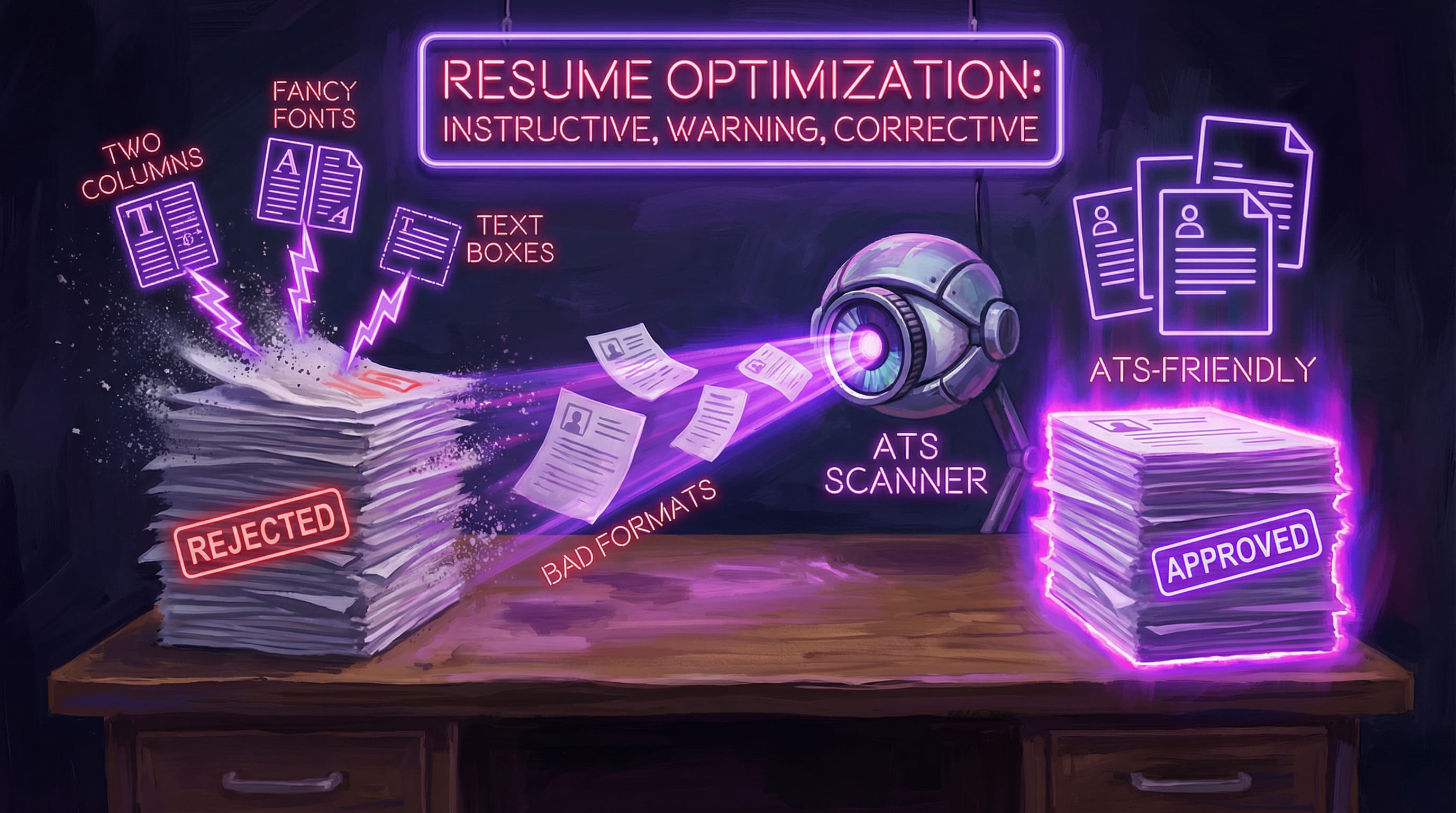
Bad Resume Examples: What NOT to Do in 2026 (And How to Fix It)
Avoid the resume mistakes that get you auto-rejected. See real examples of bad formats versus modern, ATS-friendly layouts.

Career Change at 30, 40 or 50: A Practical 2026 Roadmap
A comprehensive guide to pivoting your career mid-life, with strategies for self-assessment, transferable skills, and overcoming age bias.

How to Write a Resume with No Experience (Student & Entry Level)
A complete guide for students and entry-level professionals to landing their first job.