How to Write a Resume with No Experience (Student & Entry Level)
A complete guide for students and entry-level professionals to landing their first job.
12 days ago - Updated 2 days ago
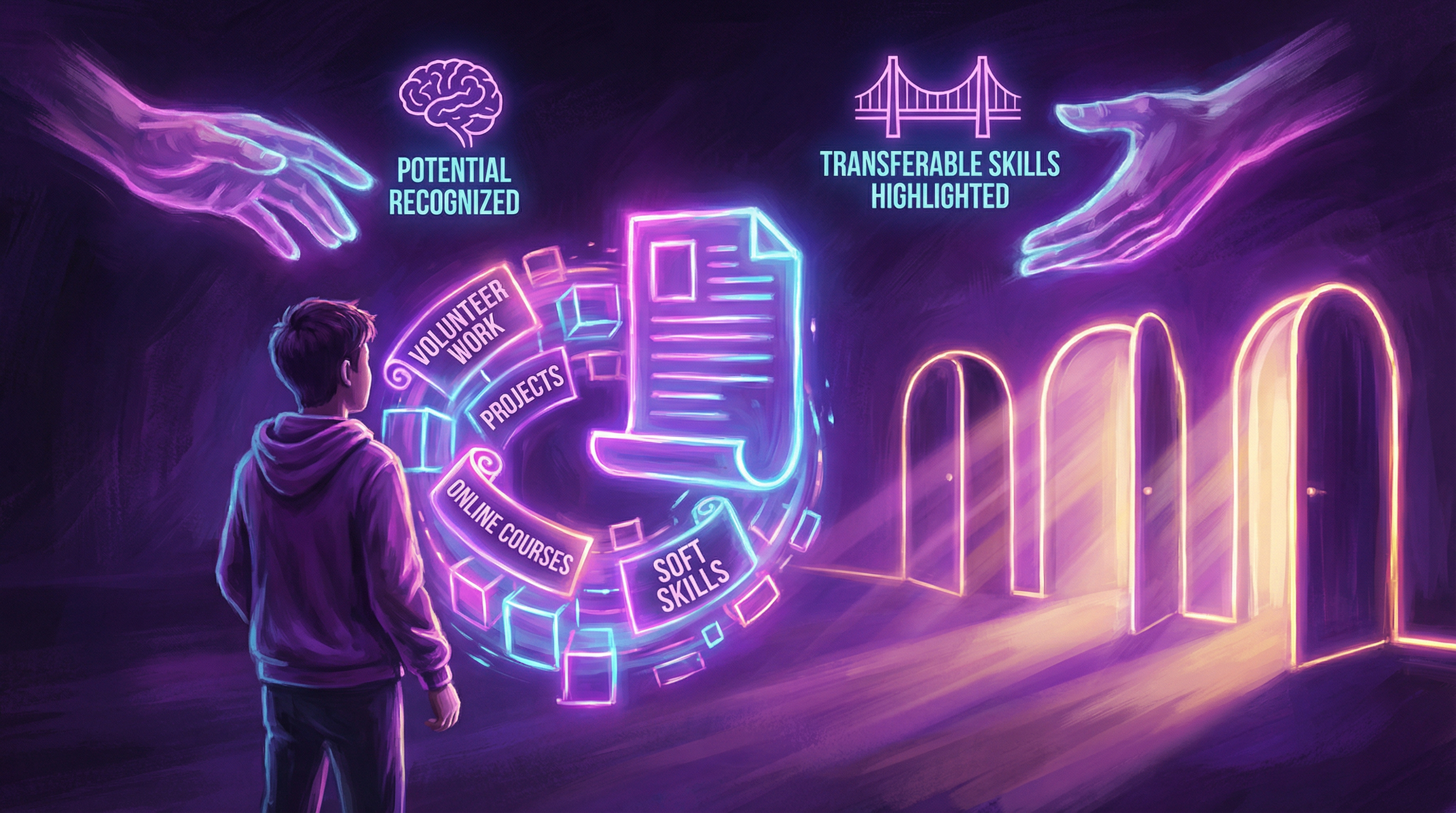
No work experience? No problem. This guide shows you exactly how to create a compelling resume using your education, skills, projects, and volunteer work. You'll learn:
- Which resume format works best for beginners (Functional vs. Combination)
- How to optimize for ATS systems that screen 80% of resumes
- Proven formulas for writing achievement-focused bullet points
- 3 complete resume examples you can adapt
- Common mistakes that get entry-level resumes rejected
Introduction
Staring at a blank resume template when you've never had a "real job" can feel like being asked to build a house without any materials. But here's the reality: 78% of hiring managers say they'd hire a candidate with no direct experience if they demonstrate the right skills and potential.
You might be wondering: "How can I impress employers when I've never had a job?" The truth is, employers understand that everyone starts somewhere. Entry-level positions exist specifically for candidates like you. What they're really looking for isn't years of experience—it's potential, enthusiasm, relevant skills, and the ability to learn quickly.
The secret? Strategic repositioning. Instead of focusing on what you don't have (job history), you'll showcase what you do have:
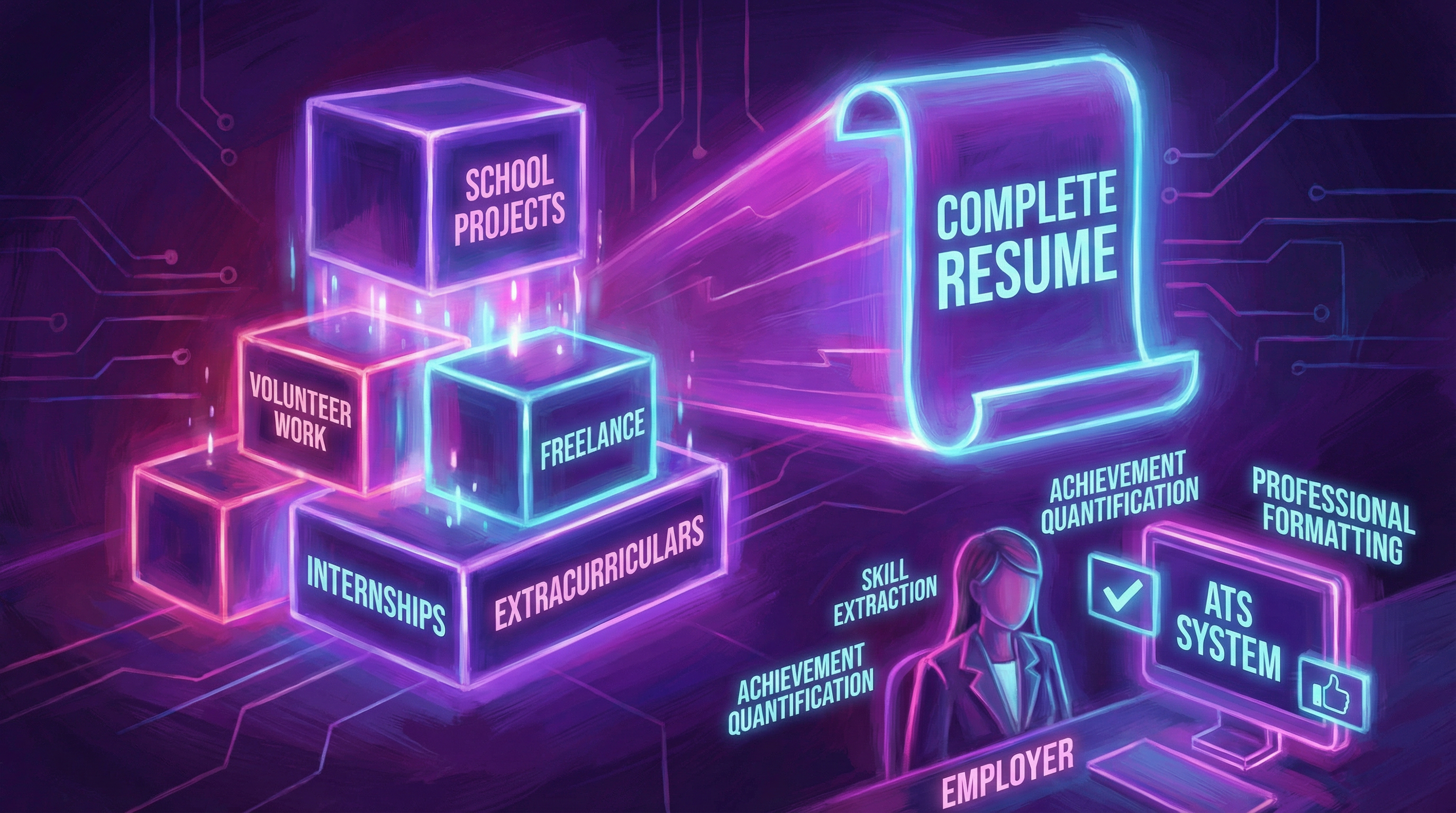
- Education and academic achievements that demonstrate knowledge
- Transferable skills developed through coursework, clubs, and extracurriculars
- Projects and volunteer work that show real-world application
- Certifications and training that prove initiative
- Passion and eagerness to contribute and grow
This comprehensive guide provides a step-by-step blueprint for creating a resume that gets noticed, passes ATS screening, and lands interviews—even with zero professional experience. Let's turn your perceived weakness into your greatest strength.
Understanding Your Starting Point
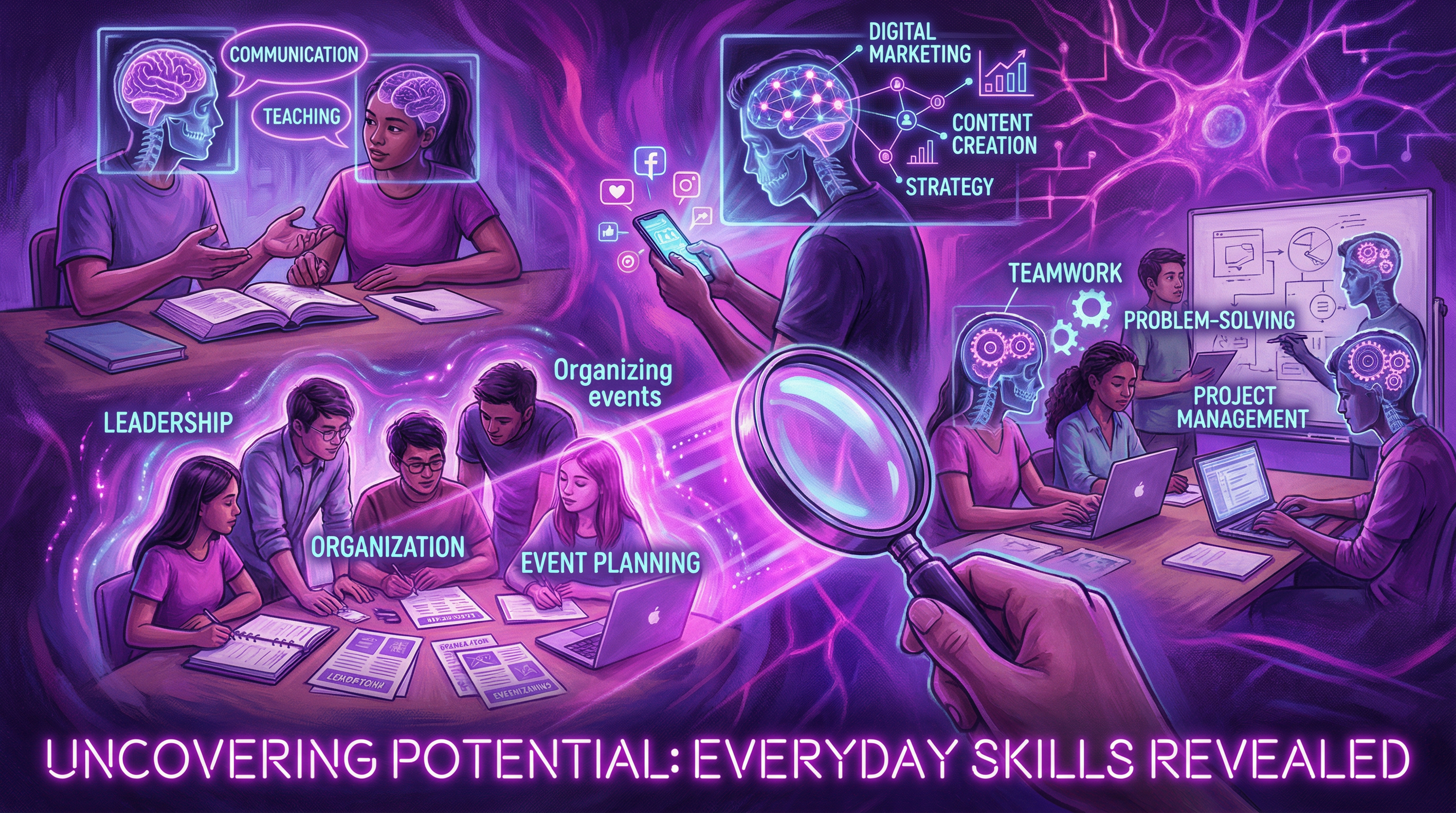
Before you begin writing, recognize the assets you already have. The key mindset shift: experience ≠ paid employment. Anything that developed skills, demonstrated responsibility, or required problem-solving counts.
What Counts as Experience (Even Without a Job)
💡 Pro Tip: If an activity taught you a skill, required leadership, involved collaboration, or produced measurable results—it's resume-worthy experience.
Formal Experience:
- Internships (paid or unpaid)
- Part-time or seasonal work
- Freelance or contract projects
Academic Experience:
- Class projects with measurable results
- Relevant coursework matching the job description
- Research papers or case studies
- Group projects demonstrating teamwork
Extracurricular Activities:
- Leadership roles in clubs or student organizations
- Volunteer work or community service
- Event planning or coordination
- Mentoring or tutoring peers
Personal Projects:
- Personal portfolio work (for creative fields)
- Self-directed learning or certifications
- Open-source contributions (for tech roles)
- Side projects completed independently
The goal is to think creatively about anything that demonstrates skills the employer values, then translate that experience into resume language.
Choosing the Right Resume Format
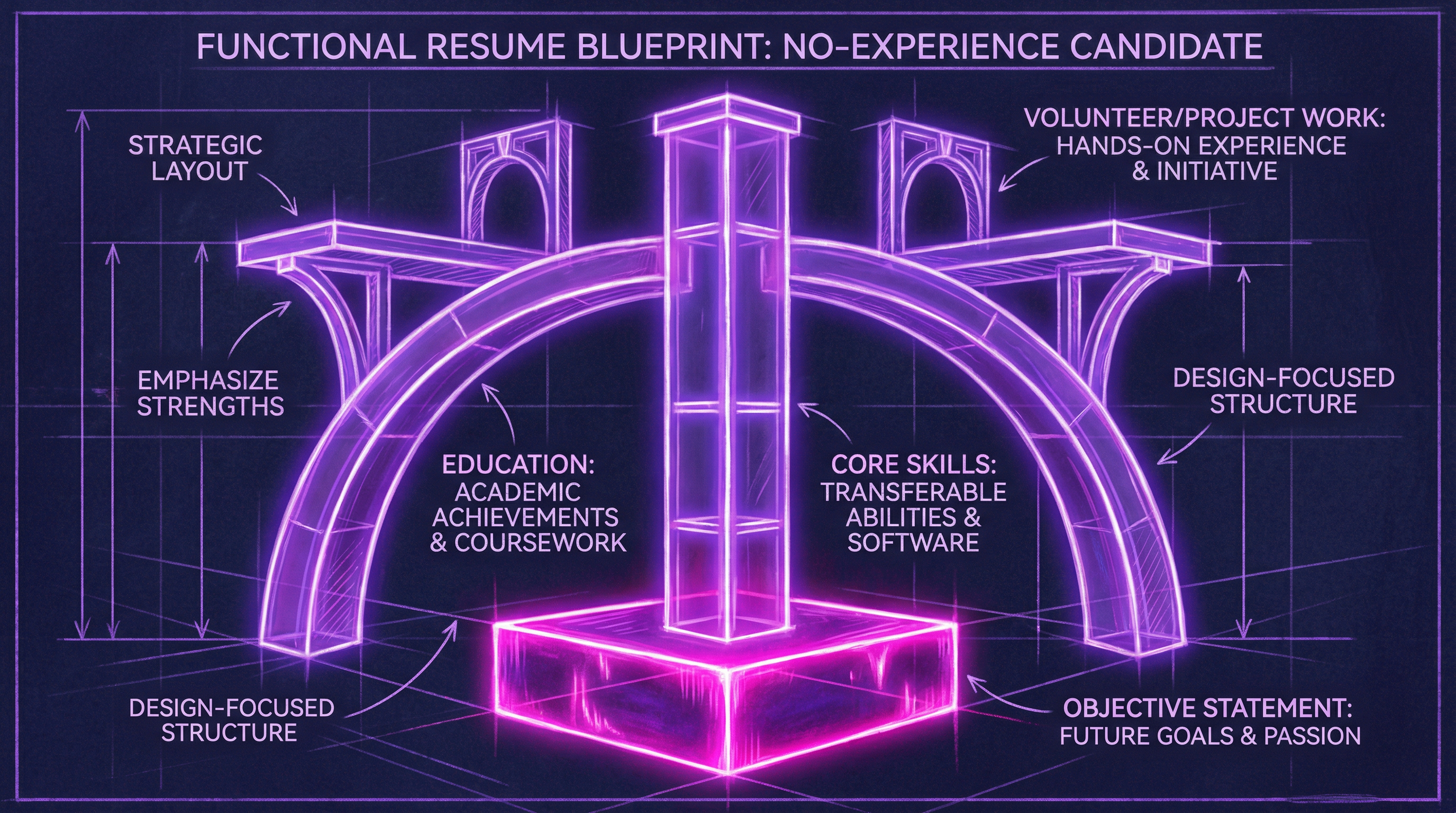
Resume format matters because it determines how effectively you present limited experience. For candidates with no job history, two formats dominate:
1. Functional Resume Format (Recommended for No Experience)
The functional format emphasizes skills over work history. It groups your abilities into categories and places education prominently.
Best for:
- Students with zero work experience
- Career changers
- Those with gaps in employment
Structure:
- Contact Information
- Professional Summary or Objective
- Core Skills (organized by category)
- Education
- Volunteer Work / Projects (if applicable)
- Certifications or Awards
Advantage: Highlights what you can do rather than what you haven't done yet.
2. Combination (Hybrid) Resume Format (Good if you have any experience)
This format balances skills and experience equally, making it versatile for those with internships or volunteer work.
Best for:
- Students with one or more internships
- Entry-level candidates with volunteer experience
- Those transitioning fields
Structure:
- Contact Information
- Professional Summary or Objective
- Core Skills
- Relevant Experience (or Internships / Projects)
- Education
- Additional Sections (certifications, awards)
Advantage: Lets you highlight both capabilities and the practical experience you do have.
Why Avoid Chronological Format
The chronological format lists jobs in reverse order and is designed for candidates with extensive work history. It will make your resume look sparse and weak if you have little to no experience.
📊 Quick Decision Guide:
- Zero experience? → Functional Format
- 1-2 internships or volunteer roles? → Combination Format
- 3+ relevant positions? → Chronological Format (standard)
Resume Sections Explained
Contact Information
Place this at the very top of your resume.
What to include:
- Full name
- Phone number (ensure voicemail is set up professionally)
- Professional email address (use firstname.lastname@email.com format)
- City and state (or city, country if internationally applicable)
- LinkedIn URL (optional but recommended)
- Portfolio website or GitHub (if relevant to the role)
Example:
EMMA JOHNSON
Boston, MA 02101
(617) 555-0147
emma.johnson@email.com
linkedin.com/in/emmajohnson
Pro Tip: Don't include your full residential address—city and state are sufficient for privacy and safety reasons.
Professional Summary or Objective
This 2-5 sentence section appears directly below your contact information and serves as your elevator pitch.
Use an Objective When:
- You have zero work experience
- You're applying for an internship or entry-level role
- Your goal is clear and specific to that role
Resume Objective Structure:
[Relevant Adjective] [Degree/Background] seeking [Job Title] to apply [Key Skills] and [Passion/Goal].
Example (High School Student):
Motivated high school senior with a background in business and
communications, seeking a summer internship in marketing to apply
leadership skills, social media expertise, and strong organizational
abilities to support campaign development and brand engagement.
Example (Recent Graduate):
Detail-oriented recent graduate with a bachelor's degree in
computer science and expertise in Python, JavaScript, and React.
Seeking a junior software developer position to contribute to
innovative projects while continuing to expand full-stack development
skills in a collaborative team environment.
Use a Summary When:
- You have 1+ internships or work experience to discuss
- You want to lead with achievements
Professional Summary Structure:
[Your background] with [years/number] of [relevant experience] in [field]. [Key achievement]. Seeking [job title] to [value proposition].
Example:
Motivated business student with one year of marketing internship
experience managing social media campaigns and analyzing customer
engagement metrics. Demonstrated ability to increase online reach
by 40% through data-driven strategies. Seeking entry-level digital
marketing role to leverage content creation and analytics expertise.
Pro Tips for Objectives/Summaries:
- Mirror keywords from the job description
- Show enthusiasm without sounding desperate
- Mention 2-3 key skills relevant to the specific role
- Keep it to 3-4 lines maximum
Skills Section
For candidates without work experience, the skills section becomes your competitive advantage. It's where you show what you can do. When selecting which words and traits to highlight, our guide on 150+ words to describe yourself can help you choose professional adjectives that resonate with employers.
What Skills to Include:
Hard Skills (Technical):
- Software proficiency (Microsoft Office, Adobe Suite, Figma)
- Programming languages (Python, JavaScript, Java, C++)
- Tools and platforms (Salesforce, WordPress, HubSpot)
- Language proficiency
- Data analysis tools (Excel, Tableau)
Soft Skills (Transferable):
- Communication
- Teamwork and collaboration
- Problem-solving
- Critical thinking
- Time management
- Project management
- Leadership
- Adaptability
- Attention to detail
Top Soft Skills Employers Want (2026):
- Problem-solving
- Critical thinking
- Teamwork
- Communication
- Adaptability
- Leadership
- Time management
- Creativity
- Initiative
- Emotional intelligence
How to Build Your Skills List:
- Review the job description – Identify 10-15 skills mentioned
- List all your skills – Write everything you can do (don't limit yourself)
- Match and prioritize – Select 5-10 skills that align with the specific job
- Group by category – Organize hard skills and soft skills separately
- Be honest – Only list skills you can explain in an interview
🎯 Real-World Example: Worked as a server at a restaurant? That's:
- Communication (taking orders, resolving complaints)
- Time management (handling multiple tables simultaneously)
- Teamwork (coordinating with kitchen staff)
- Problem-solving (handling customer issues)
- Attention to detail (remembering orders, processing payments)
See how "just a restaurant job" translates into 5+ professional skills?
Skills Section Format:
CORE SKILLS

Technical Skills
• Python, Java, SQL
• Adobe Creative Suite (Photoshop, InDesign)
• Google Analytics and SEO optimization
• Project management with Asana and Monday.com

Soft Skills
• Cross-functional team collaboration
• Written and verbal communication
• Problem-solving and critical thinking
• Time management and organization
• Adaptability and rapid learning
Pro Tip: Don't use single words. Phrases like "Proficiency in Python programming" and "Experience with data analysis" are more impactful than just "Python" or "Data Analysis."
💼 Work Smarter: Building a skills section from scratch can be time-consuming. CareerBoom's AI-powered resume builder automatically analyzes job descriptions, extracts relevant keywords, and generates optimized skills sections tailored to each position—saving you hours of manual work.
Education Section
For no-experience candidates, education is a major selling point. Make it substantial.
What to Include:
- School/University name and location
- Degree (B.A., B.S., High School Diploma, etc.)
- Major/Field of Study
- Expected graduation date (if still in school) or graduation year
- GPA (only if 3.5 or higher)
- Relevant coursework (3-5 courses that match the job)
- Academic honors (Dean's List, scholarships, awards)
- Key projects (if space allows)
Education Section Format:
EDUCATION

Bachelor of Science in Business Administration
University of Massachusetts, Boston, MA
Graduation: May 2026 | GPA: 3.7/4.0

Relevant Coursework: Data Analytics, Digital Marketing Strategy,
Consumer Behavior, Market Research, Business Communication

Academic Honors: Dean's List (4 semesters), $15,000 Merit Scholarship

Key Project: Developed comprehensive marketing strategy for local
nonprofit, resulting in 35% increase in social media engagement
Pro Tips:
- Only list GPA if it's 3.5 or above
- Choose coursework that directly relates to the job description
- Use the "Key Project" line to add measurable accomplishments
- If you're still in school, always include expected graduation date
Experience Section (For Limited/No Work Experience)
Without traditional jobs, reframe this section to include internships, volunteer work, and projects.
If You Have an Internship:
EXPERIENCE

Marketing Intern
ABC Marketing Agency, Boston, MA
June 2025 – August 2025

• Assisted in developing and executing social media content calendar
  for 5+ client accounts, posting 15-20 pieces of content monthly
• Analyzed website traffic and engagement metrics using Google Analytics,
  providing weekly reports to supervisors
• Collaborated with creative team to produce 12+ social media graphics
  and promotional videos
• Researched competitor strategies, documenting findings for 3 strategic
  planning sessions
Key Elements:
- Start each bullet with an action verb (see list below)
- Include specific numbers (number of projects, percentage increases, etc.)
- Focus on achievements, not just duties
- Use 5-7 words per bullet for conciseness
- Match keywords from the job description
If You Have Volunteer Work:
VOLUNTEER EXPERIENCE

Event Coordinator
Local Community Center, Boston, MA
January 2024 – Present

• Coordinated logistics for 8+ community events, managing vendor
  communications, scheduling, and budget ($2,000 average per event)
• Recruited and supervised 15-20 volunteers, providing training and
  task delegation
• Increased event attendance by 25% through targeted social media
  marketing campaigns
• Managed event registration system and created post-event surveys
  to measure community satisfaction (85% positive feedback)
If You Have Relevant Projects:
RELEVANT PROJECTS

E-Commerce Website Redesign (Class Project)
Data-driven web design project improving user experience
• Conducted user research through surveys (50+ respondents) and usability testing
• Redesigned website mockups using Figma, implementing findings from research
• Presented final prototype to marketing team and professor; feedback praised
  improved navigation and 30% estimated increase in conversion potential
• Tools: Figma, Google Analytics, user research methodologies
Pro Tip: If you truly have no internships or volunteer work, use significant class projects instead. Frame them professionally and highlight the skills developed.
Additional Sections (If Applicable)
Include these sections only if they strengthen your candidacy:
Certifications & Training
CERTIFICATIONS

• Google Analytics Individual Qualification (IQ) - Valid through 2027
• HubSpot Social Media Certification - Completed August 2025
• Hootsuite Platform Certification - Completed March 2025
Languages
LANGUAGES

• English (Native)
• Spanish (Fluent - Conversational)
• French (Elementary)
Awards & Recognition
AWARDS & HONORS

• Student of the Month - Marketing Club (March 2025)
• Outstanding Group Project - Business Communication Course (Fall 2024)
• Community Service Award - College Volunteer Services (2024)
Technical Skills / Software
TECHNICAL PROFICIENCY

• Microsoft Office Suite (Word, Excel, PowerPoint)
• Google Workspace (Docs, Sheets, Forms, Analytics)
• Canva (Social media design)
• Buffer (Social media scheduling)
• Mailchimp (Email marketing)
Step-by-Step Guide to Writing Your Resume
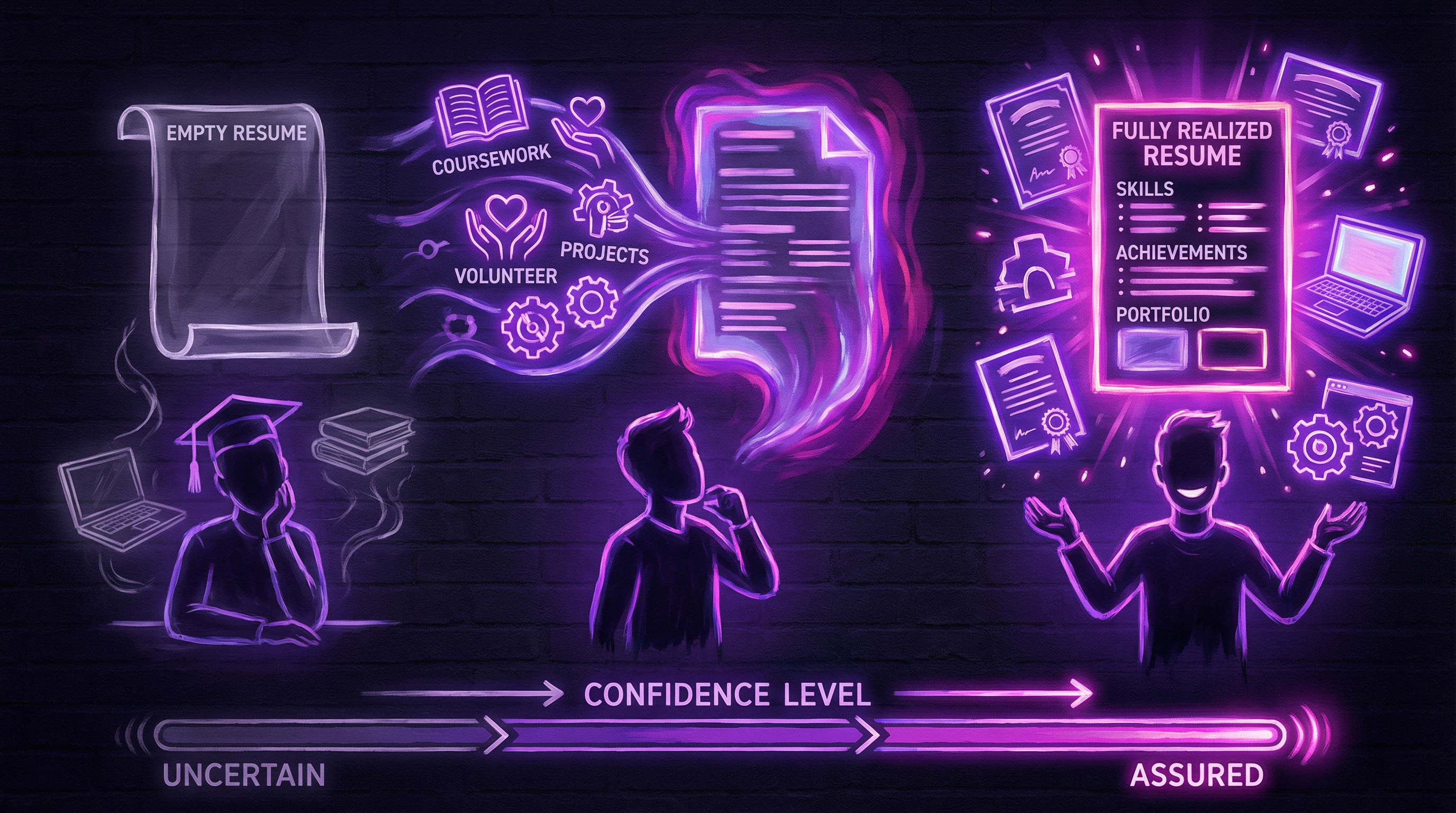
Step 1: Analyze the Job Description
Before you write anything, study the job posting thoroughly.
- Highlight 10-15 key skills and responsibilities mentioned
- Note exact job titles, tools, and terminology they use
- Identify "must-have" vs. "nice-to-have" qualifications
- Look for repeated themes (e.g., "collaborative," "data-driven," "customer-focused")
Action: Create a simple spreadsheet with skills from the job description and checkmark the ones you have.
Step 2: Inventory Your Experiences & Skills
Write everything you've done, even if it seems minor:
- All internships and part-time jobs (paid and unpaid)
- Volunteer work and community involvement
- Class projects with results
- Leadership roles
- Technical skills and tools you know
- Languages you speak
- Certifications or online courses completed
- Academic awards and honors
- Relevant hobbies or personal projects
Step 3: Translate Experiences into Achievements
For each experience, ask: "What did I accomplish? What was the impact?"
Weak Example: "Helped with social media"
Strong Example: "Developed and executed social media content strategy, increasing follower engagement by 45% over 3 months"
Use this formula: [Action Verb] + [Task/Project] + [Measurable Result/Impact]
Step 4: Choose Your Format
- No experience at all? → Functional Resume
- Have 1+ internships? → Combination Resume
Step 5: Build Each Section
Start with contact info, then move to your chosen format:
For Functional: Contact → Objective → Skills → Education → Volunteer/Projects → Certifications
For Combination: Contact → Objective/Summary → Skills → Experience → Education → Certifications
Step 6: Customize for Each Job
Don't send the same resume to every employer. Instead:
- Reorder your skills to match the job description's priorities
- Add 2-3 keywords from the specific job posting naturally into your objective
- Emphasize experiences that align with the role
- Adjust your "Relevant Coursework" section to match the position
Step 7: Format for Readability
- Use standard fonts: Arial, Calibri, Helvetica, or Times New Roman (12pt)
- Set margins to 1 inch on all sides
- Use single spacing within sections, add space between sections
- Left-align all text
- Keep to 1 page (if you have minimal experience)
- Use bullet points (maximum 5-7 per section)
- Use bold for section headers and job titles
Step 8: Optimize for ATS (Applicant Tracking Systems)
(See detailed ATS section below)
- Use standard section headings (EXPERIENCE, EDUCATION, SKILLS)
- Save as .docx or PDF (check job posting for preference)
- Avoid graphics, tables, and columns
- Use simple formatting
- Include 15-25 relevant keywords naturally throughout
🚀 Skip the Manual Work: ATS optimization can be complex and time-consuming. CareerBoom handles this automatically—our AI ensures your resume passes ATS screening while maintaining professional formatting, keyword density, and readability for human recruiters.
Step 9: Proofread Ruthlessly
- Read aloud to catch awkward phrasing
- Check for spelling and grammar errors
- Ensure consistent formatting (dates, bullet styles)
- Verify all contact information is correct
- Have 2-3 people review it
Step 10: Save & Submit Correctly
- File name: FirstName_LastName_Resume.pdf (or .docx)
- Don't use generic names like "Resume.pdf"
- Save a copy for your records
- Follow any submission instructions in the job posting
✅ Step-by-Step Recap:
You've analyzed the job → inventoried your experiences → translated them into achievements → chosen your format → built each section → customized for the job → formatted for readability → optimized for ATS → proofread thoroughly → saved correctly. Your resume is ready!
ATS Optimization for Maximum Visibility
⚠️ Critical: Approximately 80% of resumes are screened by Applicant Tracking Systems (ATS) before a human reads them. If your resume doesn't contain the right keywords in the right places, it gets filtered out automatically, no matter how qualified you are.
This is perhaps the most important section for entry-level candidates. Even a perfectly crafted resume won't get you an interview if it never reaches a human recruiter.
What ATS Systems Look For:
- Exact keyword matches from the job description
- Industry-standard terminology (use their words, not synonyms)
- Proper formatting that the system can parse correctly
- Strategic keyword placement in high-priority zones
- Relevant skills density (15-25 keywords across your resume)
How to Optimize Your Resume for ATS:
Step 1: Extract Keywords from the Job Description
Read the job posting and create two lists:
Hard Skills (Technical): Tools, software, programming languages, certifications Soft Skills: Leadership, communication, problem-solving, teamwork
Example from a Marketing Job:
MUST-HAVE KEYWORDS:
- Digital marketing
- Social media management
- Content creation
- Google Analytics
- SEO/SEM
- Email marketing
- Data analysis

NICE-TO-HAVE KEYWORDS:
- Project management
- Adobe Creative Suite
- CRM platforms
- A/B testing
Step 2: Strategic Keyword Placement
Place keywords in these high-priority zones (where ATS systems scan first):
Zone 1: Professional Summary/Objective Insert 2-3 of your most important keywords naturally.
❌ WEAK: "Seeking a position in marketing"
✅ STRONG: "Detail-oriented recent graduate with expertise in digital
marketing, social media management, and Google Analytics, seeking
entry-level marketing analyst role to drive data-informed campaigns."
Zone 2: Skills Section This is where bulk keyword placement happens. Use exact terms from the job posting.
❌ WEAK: "Good with computers"
✅ STRONG: "Google Analytics, SEO optimization, Social Media
Management (Instagram, Facebook, LinkedIn), Email Marketing
(Mailchimp, HubSpot)"
Zone 3: Experience/Project Bullets Weave keywords naturally into achievement statements.
❌ WEAK: "Worked on social media"
✅ STRONG: "Developed and executed social media management strategy
across Facebook, Instagram, and LinkedIn, increasing engagement by 40%"
Step 3: Keyword Density
- Aim for 15-25 relevant keywords throughout your entire resume
- Avoid "keyword stuffing" (overusing the same term repeatedly)
- Use both acronyms AND full terms (e.g., "SEO" and "Search Engine Optimization")
- Ensure keyword usage matches your actual skills (don't lie)
ATS-Friendly Formatting Rules:
| Do | Don't |
|---|---|
| Use standard section headings (EXPERIENCE, EDUCATION) | Use creative headers like "My Journey" |
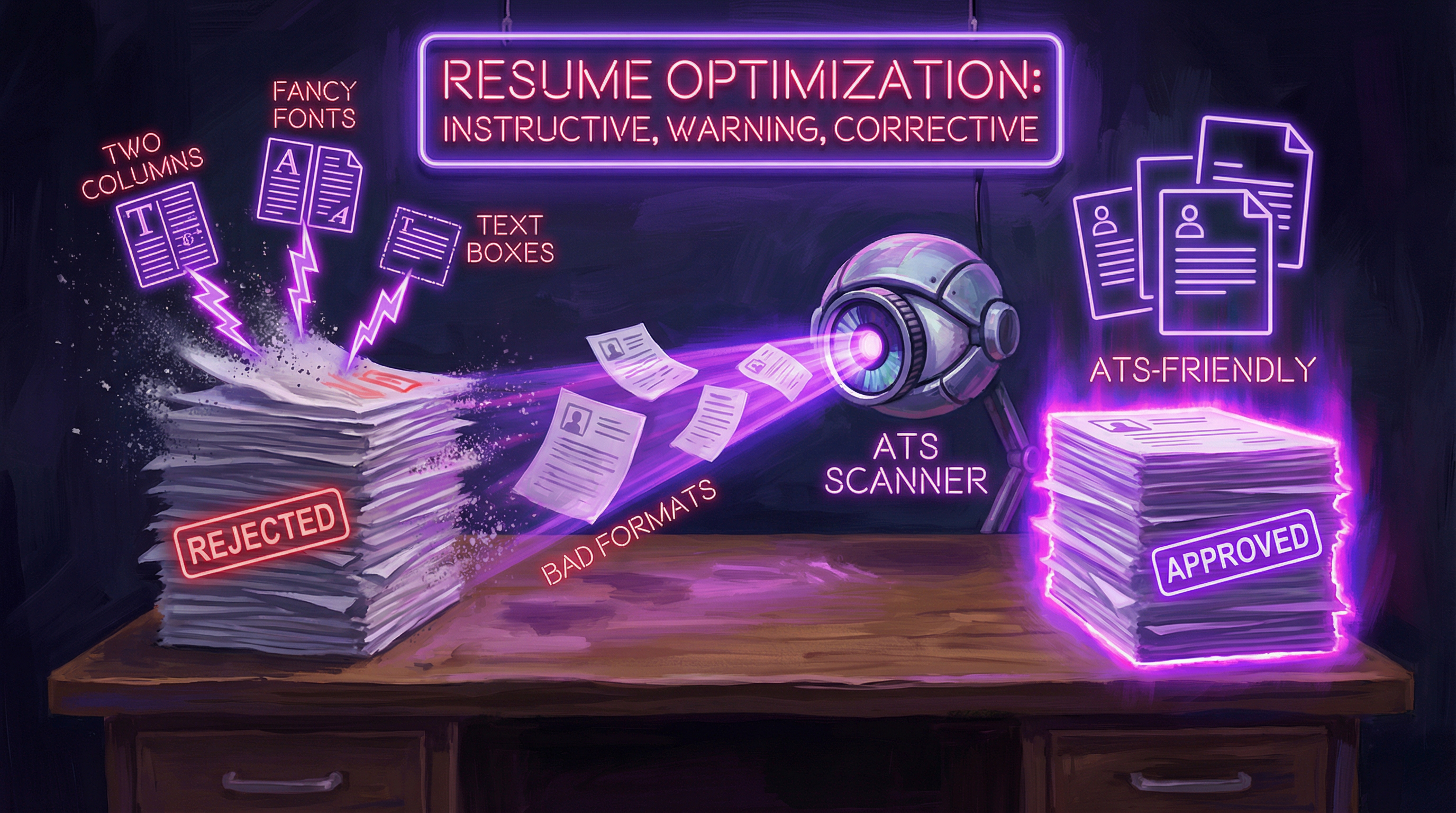
| Save as .docx or .pdf (check job posting) | Use images, logos, or graphics |
| Use simple bullet points | Use text boxes or columns |
| Left-align all content | Use fancy fonts or unusual spacing |
| Use standard font (Arial, Calibri, Times New Roman) | Use colors, italics, or underlining (except bold for emphasis) |
| List dates in standard format (MM/YYYY) | Use unexplained abbreviations |
| Use single space or 1.15 spacing | Use tables for information |
ATS Keyword Optimization Checklist:
- Extracted 10-15 keywords from job description
- Front-loaded objective/summary with top 2-3 keywords
- Added 5-10 relevant keywords to skills section
- Incorporated 2-3 keywords naturally into each experience bullet
- Used exact job title language from the posting
- Verified keyword usage matches my actual skills
- Saved resume in ATS-friendly format (.docx or .pdf)
- Used standard, simple formatting
- Tested resume on free ATS checker tool (e.g., Jobscan, ResumeWorded)
Action Verbs for Entry-Level Resumes
Starting every bullet point with a strong action verb transforms your resume from passive to dynamic. It shows initiative and makes your accomplishments stand out.
Best Action Verbs for Entry-Level Candidates:
When You Led or Coordinated:
- Arranged
- Coordinated
- Directed
- Facilitated
- Guided
- Led
- Managed
- Organized
- Oversaw
- Planned
- Spearheaded
- Supervised
When You Created or Developed Something:
- Built
- Conceptualized
- Designed
- Developed
- Engineered
- Established
- Formulated
- Innovated
- Launched
- Originated
- Produced
- Prototyped
When You Improved or Enhanced:
- Accelerated
- Enhanced
- Expanded
- Improved
- Increased
- Maximized
- Optimized
- Streamlined
- Strengthened
- Transformed
- Upgraded
When You Analyzed or Researched:
- Analyzed
- Assessed
- Audited
- Calculated
- Compiled
- Evaluated
- Examined
- Identified
- Investigated
- Researched
- Reviewed
- Tested
When You Collaborated or Supported:
- Assisted
- Collaborated
- Contributed
- Cooperated
- Facilitated
- Partnered
- Supported
- Unified
Action Verbs to Avoid (Too Common):
- Helped
- Did
- Worked on
- Responsible for
- Made
- Handled
- Involved in
These overused verbs lack impact. Choose more specific alternatives.
Using Action Verbs Effectively:
❌ WEAK: "Responsible for social media accounts"
✅ STRONG: "Coordinated social media presence across 3 platforms,
curating and posting 20+ pieces of content monthly"

❌ WEAK: "Helped with event planning"
✅ STRONG: "Orchestrated logistics for 5 community events, managing
vendor coordination and volunteer scheduling for 50+ participants"

❌ WEAK: "Did research for projects"
✅ STRONG: "Conducted market research by surveying 100+ respondents,
synthesizing findings into actionable strategic recommendations"
Common Mistakes to Avoid
Even with limited experience, there are critical errors that can sink an otherwise strong resume. Avoid these 10 pitfalls to maximize your chances of landing an interview.
Mistake 1: Including Irrelevant Experience
❌ Listing every job you've ever had, even if unrelated to the role
✅ Include only experience that demonstrates transferable skills relevant to the target job. If you worked at a fast-food restaurant, emphasize teamwork, time management, and customer service—skills that transfer to any role.
Mistake 2: Being Too Vague
❌ "Assisted with various marketing tasks"
✅ "Analyzed social media performance data and recommended optimizations that increased post engagement by 35%"
Specificity is credibility. Numbers make impact concrete.
Mistake 3: Overstating Skills You Don't Have
❌ Listing "Expert in Python" when you took one coding class
✅ List only skills you can genuinely discuss and demonstrate in an interview. You'll be asked about anything on your resume.
Mistake 4: Ignoring Keywords
❌ Using general language that doesn't match the job description
✅ Mirror the exact terminology from the job posting. If they say "digital marketing," use that phrase. If they say "content creation," include it too.
Mistake 5: Poor Formatting and Presentation
❌ Multiple fonts, inconsistent spacing, cramped text, graphics
✅ Clean, professional, single-page (for entry-level), consistent formatting, easy to scan
Your resume is a first impression. Sloppy formatting suggests sloppy work.
Mistake 6: Focusing on Duties Instead of Achievements
❌ "Responsible for answering phones and scheduling appointments"
✅ "Managed scheduling system for 15+ employees and reduced appointment no-shows by 20% through automated reminder system implementation"
Employers care about impact, not job duties.
Mistake 7: Mixing Personal and Professional
❌ Including personal hobbies, photos, marital status, age, or interests unrelated to the job
✅ Keep everything professional and job-focused. (Exception: Personal projects directly relevant to the industry, like a portfolio website.)
Mistake 8: Writing Without Proofreading
❌ Spelling errors, grammatical mistakes, inconsistent capitalization
✅ Proofread multiple times. Use Grammarly. Have others review it. One typo can cost you an interview.
Mistake 9: Lying or Exaggerating
❌ Inflating skills, making up experiences, misrepresenting achievements
✅ Be honest. Employers can verify information, and interviews will expose lies. It's better to be truthful about what you don't know—it shows integrity.
Mistake 10: Using Personal Pronouns
❌ "I led a team..." "We accomplished..."
✅ Lead with action verbs. Omit pronouns. "Led a team of 5..." is stronger than "I led a team..."
Real Resume Examples
Below are three complete resume examples demonstrating different scenarios. Use these as templates, but always customize for your specific situation and the job you're applying for.
📝 How to Use These Examples:
- Choose the example closest to your situation
- Copy the structure and formatting
- Replace content with your own experiences
- Adjust skills and keywords to match your target job
- Keep the achievement-focused bullet point style
Example 1: High School Senior (Functional Format)
MAYA CHEN
New York, NY 10001
(212) 555-0123
maya.chen@email.com
linkedin.com/in/mayachen

OBJECTIVE
Motivated high school senior seeking summer internship in digital
marketing to apply strong communication, social media expertise, and
organizational skills while gaining practical experience in campaign
development and analytics.

CORE SKILLS

Marketing & Social Media
• Social media content creation and scheduling
• Instagram, TikTok, and LinkedIn management
• Basic graphic design (Canva)
• Content strategy and audience engagement

Technical Skills
• Microsoft Office Suite (Word, Excel, PowerPoint)
• Google Analytics (foundational knowledge)
• Mailchimp (email marketing)
• Basic HTML (from web design class)

Soft Skills
• Project management and organization
• Teamwork and collaboration
• Verbal and written communication
• Attention to detail and critical thinking

EDUCATION

John F. Kennedy High School, New York, NY
Expected Graduation: June 2026

Relevant Coursework: AP Psychology, Marketing & Consumer Behavior,
Web Design, Business Communications

Academic Honors: AP Scholar (2025), Honor Roll (4 semesters),
$1,000 Merit Scholarship

VOLUNTEER EXPERIENCE

Social Media Coordinator
New York Youth Foundation, New York, NY
September 2024 – Present

• Created and scheduled 30+ social media posts monthly across
  Instagram and Facebook
• Designed 15+ promotional graphics using Canva, achieving
  25% average engagement rate
• Compiled monthly analytics reports tracking follower growth
  and content performance
• Collaborated with team to develop awareness campaigns for
  3+ community initiatives

PROJECTS & AWARDS

School Marketing Campaign Project
• Led creative direction for class project promoting school event
• Designed social media content, achieving 500+ views in one week
• Presented findings to marketing class; received highest grade

Student Government (Marketing Committee Member)
October 2024 – Present
• Support promotion of 4+ school events through digital channels

CERTIFICATIONS

• Google Analytics Individual Qualification (In Progress)
• Canva for Social Media Design (Completed, 2025)
Example 2: Recent College Graduate (Combination Format)
JAMES RODRIGUEZ
Chicago, IL 60601
(312) 555-0456
james.rodriguez@email.com
linkedin.com/in/jamesrodriguez

PROFESSIONAL SUMMARY

Recent graduate with bachelor's degree in marketing and one year of
internship experience in digital marketing and social media strategy.
Demonstrated ability to develop data-driven campaigns that increased
engagement by 45%. Seeking entry-level marketing analyst position to
leverage analytics expertise, content creation skills, and passion
for brand development.

CORE SKILLS

Digital Marketing & Analytics
• Google Analytics and conversion tracking
• Social media platform management (Facebook, Instagram, LinkedIn, Twitter)
• Email marketing (Mailchimp, HubSpot)
• SEO/SEM basics and keyword research
• A/B testing and data analysis

Content & Creative
• Content creation and copywriting
• Graphic design (Canva, Figma basics)
• Video editing fundamentals (Adobe Premiere)
• Blog management and WordPress

Technical & Professional
• Microsoft Office Suite (Excel, PowerPoint, Word)
• Google Workspace (Docs, Sheets, Analytics)
• Basic SQL for data queries
• Project management (Asana)
• Excellent communication and presentation skills

EXPERIENCE

Marketing Intern
BrightWave Digital Marketing, Chicago, IL
June 2025 – August 2025

• Executed social media content strategy for 8 client accounts,
  creating 60+ pieces of monthly content across platforms
• Analyzed website traffic and user behavior using Google Analytics,
  providing weekly performance reports to supervisors
• Collaborated with creative team to produce 24 social media graphics
  and 8 short-form videos, increasing average post engagement by 45%
• Researched competitor strategies and industry trends, presenting
  findings in 4 strategic planning meetings
• Developed email marketing campaigns using Mailchimp, achieving
  28% average open rate (12% industry benchmark)

Campus Sustainability Ambassador
Northwestern University, Chicago, IL
January 2024 – May 2025

• Coordinated awareness campaigns promoting sustainable practices
  to 2,000+ students via social media and posters
• Organized 6 campus events with 150+ attendees per event
• Mentored 4 new ambassadors, providing training and ongoing support

EDUCATION

Bachelor of Science in Marketing
Northwestern University, Chicago, IL
Graduated: May 2025 | GPA: 3.6/4.0

Relevant Coursework: Digital Marketing Strategy, Consumer Behavior
Analysis, Marketing Analytics, Market Research, Social Media Marketing,
Business Communication

Academic Honors: Dean's List (4 semesters), Marketing Award for
Outstanding Capstone Project (2025)

Capstone Project: Developed comprehensive digital marketing strategy
for local nonprofit, resulting in 35% increase in social media
followers and 40% increase in website traffic over 6 months

CERTIFICATIONS & TRAINING

• Google Analytics IQ Certification (Verified, Valid through 2027)
• HubSpot Social Media Certification (Completed August 2025)
• Hootsuite Social Marketing Certification (Completed March 2025)
Example 3: Student Applying for Internship (Functional Format)
PRIYA PATEL
San Francisco, CA 94102
(415) 555-0789
priya.patel@email.com
linkedin.com/in/priyapatel

OBJECTIVE

Analytical and detail-oriented sophomore majoring in data science,
seeking summer data analyst internship to apply Python programming,
statistical analysis, and data visualization skills while gaining
practical experience with real-world datasets and business analytics.

CORE SKILLS

Technical & Programming
• Python (Pandas, NumPy, Matplotlib, Scikit-learn)
• SQL and database querying
• Excel (VLOOKUP, pivot tables, data analysis)
• Tableau and Power BI (introductory level)
• R programming (foundational)
• Jupyter Notebooks

Analytical & Statistical
• Descriptive and inferential statistics
• Data visualization and interpretation
• Hypothesis testing and A/B testing basics
• Data cleaning and preparation
• Trend analysis and forecasting

Professional & Soft Skills
• Problem-solving and critical thinking
• Attention to detail
• Teamwork and cross-functional collaboration
• Written and verbal communication
• Time management and organization

EDUCATION

Bachelor of Science in Data Science (In Progress)
University of California, Berkeley, CA
Expected Graduation: May 2027 | Current GPA: 3.8/4.0

Relevant Coursework: Introduction to Data Science, Statistics &
Probability, Python for Data Analysis, Databases & SQL, Data
Visualization, Machine Learning Fundamentals

Academic Honors: Scholarship for Excellence in STEM (2025),
Honor Roll (2 semesters)

RELEVANT PROJECTS

Data Analysis Project: Student Housing Market Analysis
• Collected and cleaned real estate data from 500+ listings
• Analyzed price trends, location factors, and amenity impact using
  Python and Excel
• Created Tableau visualizations presenting findings to classmates
• Identified market insights that could inform pricing strategies

Web Scraping & Analysis Project
• Wrote Python script to scrape and analyze 1,000+ product reviews
  from e-commerce site
• Used NLP techniques to identify sentiment and key themes
• Presented results in professional report with 15+ visualizations

VOLUNTEER EXPERIENCE & INVOLVEMENT

Data Literacy Tutor
Berkeley Community Center, Berkeley, CA
September 2024 – Present

• Tutored 3 high school students in statistics and Excel basics
• Developed lesson plans and practice datasets
• Improved students' understanding of fundamental statistics concepts

Technology Ambassador
UC Berkeley Computer Science Department, Berkeley, CA
January 2025 – Present

• Mentored 5 first-year students interested in data science careers
• Shared resources, project ideas, and career guidance
• Organized monthly study sessions for Data Science course

CERTIFICATIONS

• Google Data Analytics Professional Certificate (In Progress)
• DataCamp Python for Data Science Track (Completed, 2025)
Conclusion
Writing a resume with no experience is challenging but absolutely achievable. Remember these core principles:
- Reframe your experience – Internships, volunteer work, class projects, and extracurriculars all count
- Focus on transferable skills – Teamwork, communication, and problem-solving matter in every industry
- Show impact with numbers – Quantify your achievements whenever possible
- Customize for each job – Mirror the job description's language and priorities
- Optimize for ATS – Include relevant keywords naturally to pass automated screening
- Be honest – Never lie about skills or experience; it will be discovered
- Polish ruthlessly – Presentation matters; one typo costs you an interview
Your lack of experience isn't a weakness—it's an opportunity to show your enthusiasm, potential, and eagerness to learn. Employers know everyone starts somewhere. The question is: are you ready?
Once your resume is polished, explore high-paying remote jobs that don't require a degree to find entry-level opportunities that match your skills and ambitions.
Frequently Asked Questions
How long should a resume with no experience be?
Keep your entry-level resume to one page. Recruiters spend an average of 6-7 seconds on initial resume screening. A concise, well-organized single page is more effective than a padded two-pager.
Should I include my high school on my resume if I'm in college?
If you're in college: Only include high school if you have significant achievements there (valedictorian, national awards, relevant activities). Otherwise, focus on your current education.
If you're a recent high school graduate: Absolutely include it as your primary education credential.
Can I lie about my experience to get my first job?
Never. Lying on your resume can get you fired immediately if discovered, damage your professional reputation permanently, and even result in legal consequences. Instead, reframe legitimate experiences (volunteer work, school projects, extracurriculars) using professional language.
What if I have literally nothing to put on my resume?
If you genuinely have no experience, start building it now:
- This week: Sign up for a free online certification (Google Analytics, HubSpot, Coursera)
- This month: Start a relevant personal project or volunteer with a local organization
- Next month: Join a professional club or organization in your field
Meanwhile, emphasize your education, coursework, and transferable skills from any life experience.
Should I use a resume template or create my own?
Use a simple, ATS-friendly template from reliable sources (Microsoft Word built-in templates, Google Docs, or Canva's professional templates). Avoid overly creative designs with graphics, which confuse ATS systems.
How do I explain gaps in my education or timeline?
For entry-level candidates, gaps are less problematic. If asked:
- Be honest but brief
- Focus on what you learned or did during that time
- Redirect conversation to your current skills and enthusiasm
Is a cover letter necessary when you have no experience?
Yes, more than ever. A well-written cover letter lets you:
- Explain your enthusiasm and motivation
- Address the experience gap proactively
- Showcase your personality and communication skills
- Demonstrate you've researched the company
When you lack professional experience, a compelling cover letter can make the difference between landing an interview and being overlooked. Learn how to write a cover letter that highlights your potential and compensates for limited work history.
Was this article helpful?
Table of Contents
Introduction
Understanding Your Starting Point
Choosing the Right Resume Format
Resume Sections Explained
Step-by-Step Guide to Writing Your Resume
ATS Optimization for Maximum Visibility
Action Verbs for Entry-Level Resumes
Common Mistakes to Avoid
Real Resume Examples
Conclusion
Frequently Asked Questions
Share this article
Other articles
Bad Resume Examples: What NOT to Do in 2026 (And How to Fix It)
Avoid the resume mistakes that get you auto-rejected. See real examples of bad formats versus modern, ATS-friendly layouts.

150+ Words to Describe Yourself (With Examples)
A comprehensive guide to articulating your strengths, personality, and unique qualities.
How to Write a Cover Letter That Actually Gets Read
Your guide to writing cover letters that get noticed by recruiters and beat the ATS.